Blind luck, to arrive in the world with your properly formed parts in the right place, to be born to parents who were loving, not cruel, or to escape, by geographical or social accident, war or poverty. And therefore to find it so much easier to be virtuous.
Ian McEwan – The Children Act
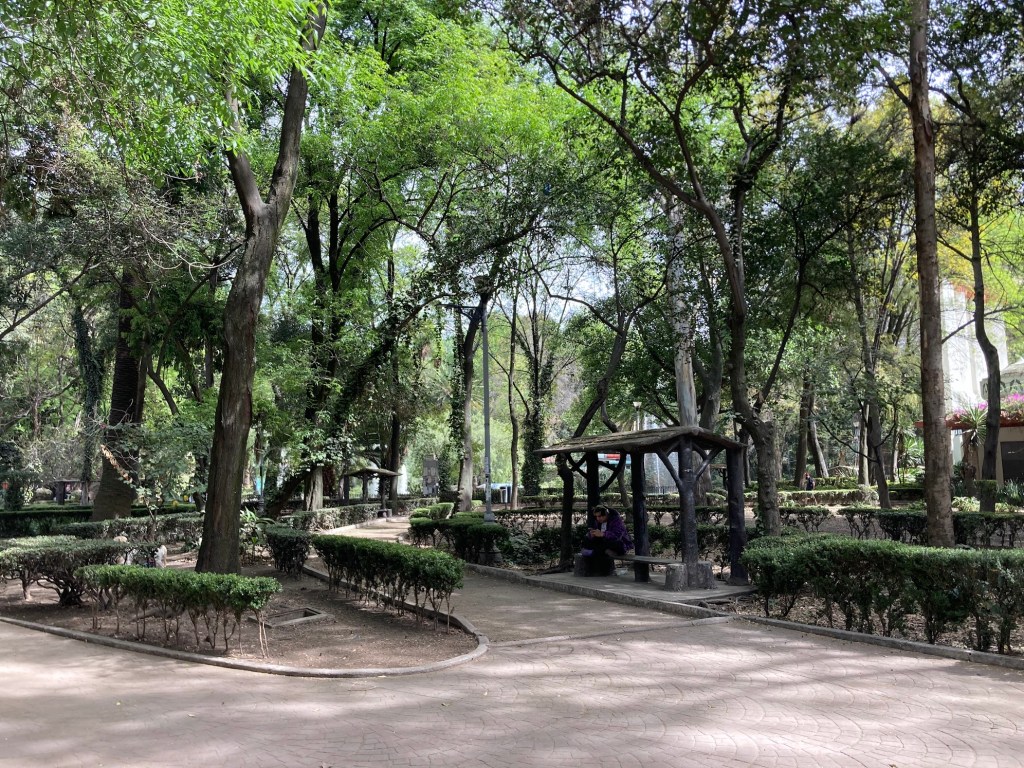
On a Monday afternoon in Mexico City, Parque Mexico is quiet. On the big, open, sun-drenched plaza in the centre, there are a few skaters, kids on bikes and a stray ball. Around the edges sit idle workday citizens, some reading, some phone-scrolling, others space-staring. Dogs everywhere, of course. A lot of people are alone, like me, and are sharing a reverence for the last sunny days of 2023. Scatterings of English in the distance, mostly Spanish though. The payment for this beautiful little oasis in the city is minor donations to musicians, poets, beggars, charities etc. Not a burden. Their approaches are polite, and not too persistent, and the rejection of the locals is always polite and respectful with the obligatory Gracias or two.
On a Sunday from midday onwards, the park is a different experience, packed with families, kids, couples with dogs, the full gamut of activities in every corner. One evening I saw a bloke with his table and typewriter set up in the park. Composing original poetry for the discerning passer-by. In two languages no less. I have so far bought original poems for 20 pesos from three separate drifting self-published writers, and can reasonably claim to be the owner of an only-one-in-the-world work of art. In the afternoon, there are mass groups of dancers of different genres, stylistic subtleties lost on me. Their music overlaps and clashes. No bother. In the density of a megalopolis, rejoice in the exploitation of rare nooks of public space.
Kids playing in the fenced-off playground, parents on the inside, kid-free couples on the outside, separated by only a fence but worlds apart. Masses of dogs and their owners or should that be humans and their masters? On the pathway, there are dogs for adoption, as if this area of the city is not already overwhelmed with canine presence. The dog dominance is generally positive, adding a certain vibe to the park and its surroundings, as long as one walks the streets with a vigilant eye on the ground. There are signs saying the park is yours and treat it as such and the park patrons tend to.
A mobile dog wash, thriving. A mobile coffee cart, booming. A classical guitarist of a late afternoon. The local orchestra and a Christmas concert. A gym area tucked between the trees. Roaming musicians of varying skill, scattered homeless blissfully asleep on benches. Unrushed, unmoved-on. Young couples seeking shadows. Food, chips, drinks of all types, savage jewellery (joyeria salvaje), further gangs of youths dancing in unison, a man on a corner selling quite large pieces of furniture and the occasional, ragged dog-whisperer somehow walking eight dogs together, all obedient and in total lockstep. People selling random junk for persuasive kids or vulnerable carers, poor ethnic sellers of colourful blankets, and an Indian man of infinite positivity attempting to sell a small wooden elephant. And my favourite spot, the audiorama, a little secluded garden with gentle music, rules for silence, and scattered chairs for reclusive reading or rumination.
A noticeboard, always a great insight into local goings-on, advertises singing classes, dog walking, rooms for rent, nutritional advice, psychology, dance classes, local markets (tianguisi), massage, tattoos, piercing or a free walking tour of the neighbourhood.
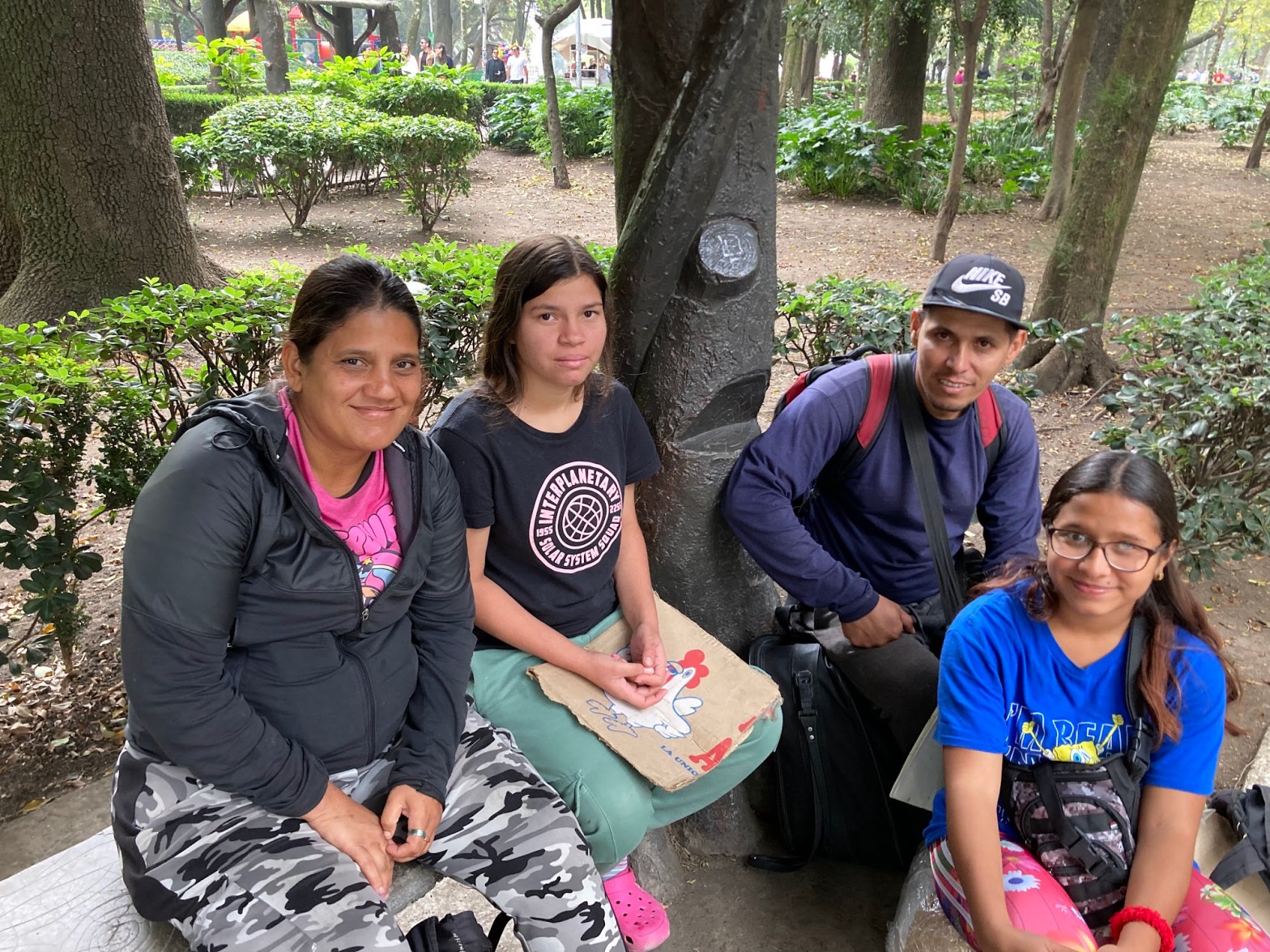
Into this idyllic scene enter, incongruously, three Venezuelan people. The nucleus of a family with members the world over. Carrying backpacks full of their life belongings, they were begging out the front of Walmart a few blocks over and came to the park to perhaps sense or observe the beauty of life for an idle citizen on a Sunday afternoon. Their worries (the citizens) are petty and inconsequential like what to eat tonight, what to watch, how to feel, or the annoying boss, the frustrating job that awaits on a Monday. These worries, creeping Sunday afternoon mini-dread, are nothing, a pathetic indulgence when juxtaposed with those of the anonymous, roving family. A cool breeze just passed, relief from the sun, but what cool relief have these people enjoyed in the last decade of their lives?
Deep believers in God, regular and sincere referrers to mi padre, el señor, mi Dios, they have been ill-served by the great granter of luck in the sky. The family from Venezuela is stuck on pause in the middle of a monumental journey that evokes memories of 19th-century novels, where an intrepid main character traverses continents over days, months, and years.
They have walked across continents, and will walk still it seems. From Venezuela, an international cautionary tale, they sought better conditions in neighbouring Colombia, and stayed there for a few years, before walking through Ecuador to Peru. Then, less than two years later, victims of further circumstance and the political manoeuvrings in the distant capital, they decided to move north, towards the very distant and dubious beacon of freedom and opportunity called the USA. In that vast and crazy wild land of 330 million diverse characters (more guns than people, don’t forget), politics rages on interminably, and the ‘migrant problem’ is a hot potato, thrown recklessly at anyone for just a sniff of political gain. But that world of Washington DC, Florida, Texas or California might as well be Mars to someone putting one foot in front of the other for years and seriously considering walking from Peru, by way of Ecuador, Colombia, Panama, Costa Rica, Nicaragua, Honduras, El Salvador, Guatemala and Mexico to seek asylum, safety, work, stability and basic human dignity.
The aforementioned countries, mostly newsworthy for coups, creeping dictatorships, murder rates, occasional World Cup appearances and general turmoil, are not tiny hamlets like Luxembourg, walkable in a day or two for a vigorous retiree. Colombia’s north is a treacherous forest. Entry to Panama by boat only to face mountain ranges. Formidable geographical challenges are exacerbated by the hostility of humans along the way.
Juan Carlos, 37, has seven children in Venezuela. He left school after primary school. He left Venezuela in 2016. He is travelling with his partner, Johana and Johana’s daughter, Zulanyerla.
“I had a job, but we couldn’t get medicine. My pay wasn’t enough to pay for food. Those who had something to sell sold it. If you had a car, you sold it for parts.”
“Those that cheat, those willing to do illegal things, and the ones who work with the government, they can survive and be better off. But those who don’t have their monthly salary to live on and at least the majority of us who left did not have the possibility, to cheat, to work, to work with the government. Without an education, you can’t work for the government.”
Juan Carlos moved to Colombia first, and the others followed a few years later. In decades past, many Colombians moved to rich Venezuela to escape violence and poverty at home. More recently, the reverse has occurred, with Colombia playing host to thousands of Venezuelans coming across the border.
His children are small, his mother is already old. He has survived but has been away from home for seven years. As he moves further from Venezuela, he still talks about moving back, starting a business, being his own boss, and seeing his family.
“When I left my daughter was 1 month old.”
And being an immigrant is hard.
“Sometimes I had to work from 7 am to 10-11 pm and for less than what a Colombian gets paid. I am a construction worker and I had to abide by their rules, I worked until that hour or there was no work. And since I lived in a country where I had to pay rent and utilities, I had to abide by the conditions they set, work from Monday to Monday, without a day off, and so on and on.”
Johana left Venezuela in 2020. She worked in Colombia growing and picking onions. As the situation got harder in Colombia, they didn’t make enough to send money back home, so they packed their bags and walked/hitched to Peru in 19 days. If they didn’t get a ride, they sometimes walked 40-50 km per day. One of Juan Carlos’ sons came too. There were just four of them heading south alongside the highway. And “mountains and mountains and mountains.”
On this trip, they had their first taste of violence on the road. “She (Zulanyerla) was tired and got a ride but we couldn’t fit all four of us and the two of them (females) got in and the men driving tried to abuse them, that was in Colombia on the way to Peru. The men, before crossing the border, took them to a mountain and left them there, luckily they started to scream, she (his daughter) was punched here (in the face) and luckily there were two men walking around when they heard some people screaming, thank God they didn’t abuse any of them.
Rather than trying their luck in Lima, where Johana’s mum and her three kids live, they went further south to Chala, where Juan Carlos’ cousin worked. They lived in this mining town for nearly two years. They made enough to send money home to Venezuela.
Chala is over 500 km from the capital, Lima, in a notoriously de-centralised and conflict-ridden country. It’s in an important mining region, where mining companies, miners, government, unions and indigenous groups clash. Their description of Chala made it sound like a highly disciplined, almost fundamentalist area, segregated from and independent of law and order imposed by the distant capital. It was an indigenous town, where indigenous leaders made and enforced the law.
“Chala was a very peaceful town. There was no government, there was no police force. The citizens maintained order. If someone stole, they didn’t kick him out but made an example of him in the square and that was a lesson for everyone. Who would want to steal anymore, and the one who smoked in the street already knew what would happen to him?”
Johana: “They couldn’t smoke, they couldn’t drink in the streets, they couldn’t hug or kiss each other in the street, those things were not allowed there.”
The punishments were strict, repressive even. “They would say, ‘Juan Carlos, he is in the park, he is smoking, this is the first warning, he knows he can’t do that’ in front of everybody. On the second warning, everyone came to watch. ‘These warnings were made to you, you have so many days to vacate the town to leave.’ And the offender had to leave the town.”
There was no robbery, no fighting or drinking or smoking in public. Things like cat-calling women were unacceptable.
Juan Carlos: “I was there for 2 years and the only death that I saw there was when a mine collapsed and a rock fell on a person and killed him.”
Life in Chala was peaceful. During summer they could go to the beach nearby and swim in the icy Pacific waters. They had friends, Peruvians and Venezuelans. But things changed. A common theme in Juan Carlos’ stories. The good people pay for the bad. One of Venezuela’s most powerful gangs, El tren de Aragua, became more prominent abroad, and their brand of violence affected Peruvian’s opinions of Venezuelans. Suddenly, there was no difference between good and bad, Venezuelans had to leave. Peru had its own problems, an imprisoned president, and a country beset by protests and unrest.
“We couldn’t strike, but as workers in Chala we were under pressure to protest with colleagues, but as foreigners, we couldn’t. The guards warned us, if we participated in the protests we would be put in jail and treated as terrorists.”
So the four of them packed their bags and left and headed north to team up with a group of ten friends in Colombia and walk or hitch country by country to Mexico, then wait and try to enter the states, legally or illegally. Juan Carlos delivers the news of this dramatic change in circumstances with the typically neutral voice he uses to deliver all information, no matter how shocking.
The chronology and location of certain events often get confused. Their friends were waiting in Bogota, and later they mentioned Medellin. The couple discusses and clarifies and often defers to Zulanyerla for clarification. She is 16 and has missed years of school but seems to have a better memory for details. Her eyesight is failing. She rarely speaks, unless to answer a question from the adults.
The story picks up in Colombia, over 1500 km from Chala. Somehow they reach the top of the country, where they must try to enter Panama. The most treacherous route involves walking through a so-called impenetrable forest, a ‘green hell’ – the 100 km of Darien rainforest. Over 200,000 people a year attempt the trek and attempt to survive local mafias, extortion, tropical diseases, wild animals, sexual violence, tropical insects, raging rivers and rain. Some get through, but the path is littered with bodies. The Venezuelan group went to Necocli, where they stayed for weeks to earn enough money to pay for a boat across the straight to the northernmost tip of Colombia. At this stage, they were only about 250 km as a crow flies from the western border of Venezuela. They crossed the Darien rainforest and then arrived at Bajo Chiquito, a once-small town now an important stopping point for the hordes of people walking north. In Bajo Chiquito people are everywhere, exhausted from walking, reuniting with friends and family, and planning their next steps.
Travelling with cash is dangerous. It may help you pay for a guide, food, water or a boat trip, but it may also get you killed or at least robbed and assaulted. Along the way, there were places to stop, but in many cases, it was just a reason for so-called authorities to charge a fee to pass.
When asked about authorities patrolling the border or restricting immigrants’ movements, Juan Carlos says: “The government is there, but as far as we can understand, the government is the same one that steals, kills and everything, the same one that is screwing the immigrants that pass through there, robbing them, kidnapping them, raping the children.” Storing money was dangerous, and some travellers stored cash internally.
They stayed in Bajo Chiquito for a few days, cleaning the streets, and helping out to try to make some money for the next part of the trip. They were waiting for other members of their group.
Says Juan Carlos: “When the others arrived they began to tell us that they had been kidnapped, the kidnappers took them to a bush, they fingered the girls, to check if they had hidden money because many hide money. We had another companion and he advised us ‘Just don’t slow down when you start walking at 7 a.m., if you can eat while walking, eat while walking, but don’t slow down, because 1 hour, 20 minutes that you lose, it’s dangerous, because you are not going to get to the place where you can really rest.” So they kept walking, suspicious of any authority figure offering refuge or safety.
He trails off, as he does with many of his stories.
The refuges along the route are ONU (United Nations) organised. What are they like? “Horrible” is the consensus. Full of thieves, smokers, “bad people”.
At one shelter they were offered food. It was cooked crow. “Our friend had eaten it and he was very sick, dying. So we decided to leave and keep walking.” Juan Carlos’ eldest son was part of their group. That core of four stayed together.
They ate tinned food, mainly tuna, biscuits and tortillas and along the route, people often gave them water. The threat of humans was one thing, but the landscape was equally dangerous. “We had to walk through some very high mountains up there against the wall, there were some ropes and the river below. A guide told us to follow the blue bags posted on the walls. They meant a safer path.”
Men walked ahead, then came back to help the women in the group. Those with small children suffered the most. Says Johana: “We saw a woman and her baby die. The woman had her baby in a pouch on her chest. As she was passing the cliff the baby came out and she threw herself after it. The father was behind them. He saw it and killed himself straight away.”
The couple tell many stories like this, all of them brief, succinct and shocking. And then they move on to something else. Zulanyerla, playing on her phone, in her good-natured way, looks up to confirm or correct certain details. “God protected us from death.”
They mentioned that they sent three or four men from their group to walk ahead of their group to look for danger or for anything that the women in the group should not see. What did those men see? “There were girls who were raped, men had also done things to them from behind because they thought the girls had money stuffed in there (the front). They saw dead children in tents, women, families of Chinese, and Haitians, stabbed to death, among the tents.
“These are things that happen in the blink of an eye. We were all in a line coming up a mountain when we saw a man step on the ground and slip. There was a friend in front, and I was behind him and we were able to grab him but we couldn’t hold on. He fell and disappeared off the cliff.”
People died often. New acquaintances drowned crossing rivers. Older people had heart attacks. Others got dengue fever and had to stop. Maybe they recovered.
Through the forest, they found their way to Panama City. They begged on the streets. “A man in a wheelchair saw Zulanyerla and started talking to her and gave us some money. With that money, we made it all the way to Costa Rica. From Costa Rica through Nicaragua to Honduras.” They spent a month in Honduras and Johana got Dengue fever. Her fever was so high she was ready to die, but without any money or documents, hospital wasn’t an option. They then arrived at the border with El Salvador.
Here Johana becomes slightly animated: “We had to enter El Salvador because we were already on the border of El Salvador and Honduras. We were already at the border, just to cross migration. That’s when migration caught us and threw us out like a piece of garbage. That was the worst thing that could have happened to us. And that was how they treated us.
There they treated us as if we were murderers, savages. They had us there with the guards so we couldn’t eat dinner, then they put us in a van in the back to take us to the border and it started pouring and we were soaked. The rain didn’t stop and we were going to get sick. They threw us out at the border and kicked us out of there like shit. I told one of them that my daughter was handicapped with her eyes and he had no compassion. ‘Get out, get out!’ as if we were dogs, not even a dog is treated like that.”
They walked through Guatemala and finally entered Mexico at the border of the southern state of Chiapas. Tapachula is where many migrants enter Mexico for the first time. Mexico is the last country before the USA, but getting from the southern border to the northern one is often as difficult as the rest of the trip to that point. It took them over three months to get from Tapachula to Mexico City. It took so long because they got sent back to Tapachula by migration police three times.
“We were really hard hit because we didn’t get much help and migration would grab us and send us back and we would be sent back again. When we had come quite a long way, when we were almost in Oaxaca (about 400 km from Tapachula), when we were already close, they would catch us and send us back to Tapachula. Three times they sent us back. We tried, but if they caught one of us, we all went back, because it was a promise we made as a group. If they send one of us back, they send us all back.
Travelling north through Mexico is not as simple as walking alongside a highway or finding the cash to buy a bus ticket and take a bus. Often drivers or locals are given an incentive to report refugees, and migration police arrest them and bus them back to the border. And the migrants start again.
They kept moving north, suspicious of buses or kombis. They stopped in some towns for a few days, if they felt the towns were safe. Juan Carlos needed to walk through the town and observe and try to decide if they could stay a few days without trouble. Sleep in a park or some public space without being detained. They had swollen feet, and bites from the forest, they were exhausted, and wanted to stop, but couldn’t risk being sent back again. They mainly walked from Oaxaca in the hot summer sun, with barely any water.
The geography of the trip becomes confusing and they talk together to try to sort out details. Were they sent back from Oaxaca or did they make it as far as Puebla before going back south for the third time? If one tries to remember details of a trip from last year or specifics from daily life last week, it is often surprisingly difficult to piece things together. One can only imagine how memories fade, blur together or are simply repressed when a journey is so exhausting, so traumatic and so long.
Here, for the first time, the family stop talking about their past and start talking about the future. They are in Mexico City waiting for an appointment for the “CPB One” visa. CPB One is an app where non-US citizens can enter information and apply for an appointment to enter the States legally. If they fulfil certain vulnerability criteria, they can enter the country through a land border directly after their appointment. A migrant can only apply for the appointment if in central or northern Mexico.
At this stage, in late November, the family had been in Mexico City for about six weeks, trying to get an appointment. After applying, they should receive a response within 15 days. They didn’t, so cleared their application and tried again. With the regular news of desperate migrants attempting to cross the southern USA border illegally every day, the chances of legal entry seem low. Yet Juan Carlos has acquaintances who have been through the process and are safe in the USA now and he is optimistic.
They were on pause in the capital. I asked them about their life here. When they first arrived, they went to the Iglesia de Soledad in the centre of the city, near Zocalo, the huge open square and tourist trap. For many of the hundreds or thousands of migrants who arrive in the city each day, this is the first point of refuge. Juan Carlos tells me that the church offers three nights of shelter to new arrivals, in tents set up inside. At about 5 pm each night, there is a long line of new arrivals. After three nights, the people must leave and try their luck in the massive, sprawling city.
One day, I planned to meet the three of them at a subway station and we travelled together to see the church. It wasn’t easy. It took us half an hour to find each other on the street outside of the station. Then we went underground, and they rushed through the turnstiles towards the platform. But they didn’t know exactly which platform led towards Zocalo station. One person turned back, another stopped, another got on an escalator and disappeared. A few minutes later they reunited, but I wondered how they had managed to stay together for so many years. We bustled onto the packed train, desperate not to miss it and be forced to wait 3-4 minutes. When we got off the train, we had to walk about 15 minutes through the chaos of mid-morning. In narrow streets, people were unpacking every possible good imaginable. The Venezuelans maintained their frenetic walking speed, dodging in and out of the crowds as if late for an important appointment. There was no appointment. We got to the church and they sat on a ledge and waited. The once-open space around the church was completely covered by tents and people. A small society had been established. There were makeshift chairs, cooking equipment, bottles of oil and water. Kids roaming. Most of the crowd were Haitian and didn’t speak Spanish. Their journey to America will be harder still.

After just one night sleeping in the church, the Venezuelan family stayed a few more nights in a hotel across the road. It was even worse. Johana showed me the bites on her legs. They preferred sleeping outside. They found parks where they could sleep in peace. They went to certain supermarkets and held up a sign saying ‘We are from Venezuela and need money to continue our trip towards the United States’. On the sign was the yellow, blue and red of the Venezuelan flag. They got some coins, but more often they received food. People sometimes stopped to chat and were amazed that they had walked so far. At some supermarkets, they were moved on by police or security.
Two weeks later, I met the family again in Parque Mexico. They brandished a piece of paper. On it was a list of 13 names. They had their appointment, their dreamed-of cita. In two weeks, they needed to be in Ciudad Juarez for the appointment, and could reasonably imagine being allowed to walk into Texas the following day. After months of walking, suffering, starving, and waiting, it all seemed so simple. Now they mentioned cities, jobs, and contacts. Texas at first. Then Chicago. Then Denver. Then Carolina, either north or south. Finally, the dream of Canada, and bringing their families to join them. But first, they had to get to Juarez, an infamously violent border city on the northern border. The last part of the journey is notorious. Thousands of migrants jump onto the top of packed freight trains and brave the trip over days or weeks. They need to pass through areas controlled by drug gangs, where violence, extortion and kidnapping run rife. The Venezuelan family refuse to do it. They have two weeks to find the money (about $300 each) for a flight.
With news of their appointment and the paper in their hands, they are positive. In times of optimism, they start to expand on the beauty of their homeland, the same failed country they had no choice but to abandon. As they move further away, and the possibility of living there again becomes more remote, they paint a picture of paradise. A utopia for the increasing amount of tourists. Safety on the streets. Royal treatment for foreigners. Natural beauty. As they keep moving, as they carry their possessions on their back, as they sleep in a different place night after night, the concept of home becomes more abstract and they can either imagine a beautiful future or re-imagine the place where they came from.
 Dark Dirt