Tuesday 8th October, 2024
Beijing, China.
Twenty years later. I hadn’t been back to the capital in a long time and to say things have changed a bit is an understatement. Ever since I’ve known the city it has been changing. Part of the charm. The noise of construction is a soundtrack to the place. The pandemic is wedged right in there like a dirty memory purged and almost forgotten by the collective populations of most of the world’s countries. Testament to the human mind. And the geopolitics of the pandemic, trade, protectionism, race and patriotism have changed the image of China, at least in Western countries. In the glory days, it was seen as a destination for the intrepid, curious traveller or businessperson. The booming economy and ancient culture were, in their unique ways, welcoming to Westerners and most foreigners. It was open, safe and interesting. Now not so much, at least in our minds.
So my plan is to take advantage of the hassle-free (I hope) 14-day visa on arrival and go back down memory lane, hoping that the famous lanes of the city still have the same eerie vibe that engrossed me 20 years ago. That anniversary passed just a couple of months back, and I only realised it when I started writing. In 2004, I arrived in late August. Callow, naive, totally overwhelmed by the city. The late summer heat, the endless traffic, crowds, noise and smells. Yes, smells that enter the bloodstream and form a touchstone to memories that are physical.
I would start at the beginning in Jiu Gu Lou Da Jie, where the school that I started working at was based. Then trace my steps through my history. About a year or two per day I suppose, seeing as I lived there nearly a decade. From the inside the second ring road out to the 4th, half a year in Tianjin, time back in Australia and finally back in Beijing in time for the Olympics, the great national landmark of the early 2000s. The coming-out party. We all just had to be there for that. A doomed experiment maybe, to always look back.
A long flight from Melbourne to Guangzhou then another few hours up to Beijing, arriving around midnight. I had been away a while and the new Daxing airport was up and running. Massive like all public buildings and 50 km from the city centre but they had a high-speed train into town to connect with the subway. No point even mentioning Melbourne’s eternal struggle to build a train to its airport. Unfortunately, I was too late and had to get a cab. We sped south towards the ring roads and as we hit the 4th I looked out and started to recognise the different names of parts of the city. How many times had I taken a late-night taxi home from home, from the other airport, heading south past the 4th, 3rd and second ring roads as the traffic thickened and thinned and thickened again and the city glowed in an eerie orange darkness? Those memories came flooding back as I headed into one of the still-standing ancient parts of the city.

When I was sick in late March, I lost my mind for a few days. My cognitive abilities disappeared in the space of a few weeks and for two or three days in hospital, I couldn’t even form a coherent sentence. Slowly I recovered, and memories of my 20s, formative years, flooded back and I talked about a deep yearning to go back to China, specifically to Beijing, to at least rediscover my memories of the place while I could.
I arrived in Jiu Gu Lou Da Jie. Old Drum Tower road, if one was to translate it. I struggled to pay for the cab with a phone app and within a few minutes I had succeeded. The days of fumbling around for notes and receiving handfuls of change to be counted quickly in the back seat are long gone. It’s pay by app or what? Try cash at your peril. I jumped out into the empty streets and walked the five minutes in the hutong towards the hotel. There were no late-night lamb stick men cooking in holes in the wall like I recalled, but I still had a boost of energy being back, even after a pretty long day of flying.
Made it to Bamboo Gardens, a hotel my parents stayed at 18 years ago. Unchanged, it is somehow immune to the irresistible modernisation going on around it.
I put my stuff down and ran south towards the drum tower, one of the iconic landmarks that colour my earliest and most intense memories of Beijing. In the midnight hours, it still glows in the distance and the alleys around it are deserted. In a city so busy one learns quickly to revere the late nights when you can stroll around and barely see another human. It’s a different place at 1 am. One can also drink a beer on the street and sit on a bench and chat. I met Chris, who had arrived that day, and that’s what we did.
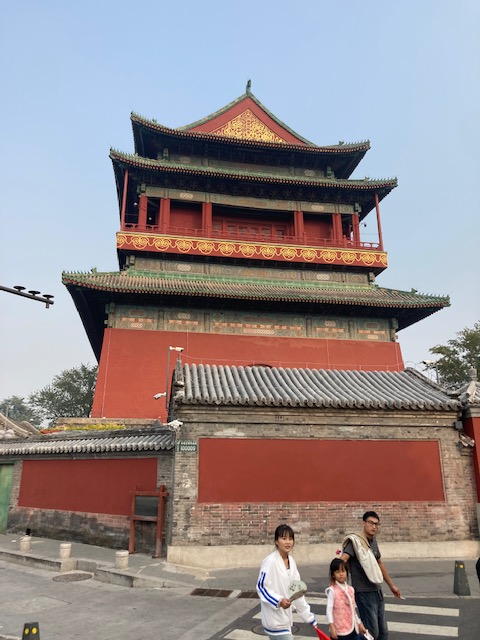
Little reminders that make me smile, like arriving at the hotel and waking the guys asleep at reception. The boy checked me in half asleep and the other guy walked me to my room. I felt energetic after my 20-21-hour door-to-door trip.
In a moment I am transported exactly 20 years back in time when I walked this neighbourhood with my teaching colleague Nathan and we sat in one of these alleys and an old gent served us some lamb sticks and a room temp beer and it was probably one of the first times that Nathan and I both realised we loved the vibe of the city as summer faded and winter approached.
Each step a new smell confronts me. Toilets are the tip of the iceberg. If only I could put a name to some of these odours. Often fragrant (around meal times), often not (around public toilets). The apparent disappearance of street food vendors has diminished the sheer quantity of aromas available for olfactory experience but it is still a relative smorgasbord.
A couple of drinks in the street then back to sleep on the blissfully rock-hard hotel bed.
Wednesday 9th
My first daylight hours.
It was always one of the great cities for dawn walks. In the hutongs people live their lives in public spaces, so one sees half-asleep locals walking to the public toilet in their pyjamas. There is always enough entertainment in people-watching.
I planned to eat breakfast at the hotel in the full knowledge that a local Chinese breakfast could be quite disconcerting. One of the best things about being confident in the language is some of the funny and confusing conversations you can have. Breakfast at Bamboo Gardens:
‘I didn’t book breakfast but can I have it?’
‘No problem. You must pay first.’
‘Sure. Do you have a menu?’
‘No. It’s a set meal.’
‘Then what will I eat?’
‘You’ll find out when you get it.’
‘Can I choose?’
‘No, it’s a set menu. You must pay first.’
Many conversations go around in a circle like that. A closed loop, if you like. Years of dedication to the language and this is your reward. Quickly you learn to smile and move on.
An old bloke smiled and said hello and I talked to him in English and he got shy.
It’s a grey city. Grey pavement, grey buildings, grey skies. Red flags. I think of Latin America, colourful, exuberant, passionate, everyone touching each other and I realise China is the complete opposite. Hutongs are magic places though.
A bloke walking aimlessly with flowers hanging from a horizontal pole over his shoulders just farted really loudly as I passed.
Smells, smells, smells.
I had arrived as the National Holiday week was ending, and the city always takes a while to get back to business. I recall the Chinese New Year holiday which happens in January and February and it always seemed like the world stopped for two months as people took trains early to head to their distant hometowns and then trickled back to work weeks later.
First impressions I wrote down. Subdued. Not as aggressively vibrant. Not as busy on the streets as it is the first couple of days after the National Holiday and it seems a lot of people aren’t back in the city yet. More respectful but people still stare. More orderly and I miss the chaos. Have seen one foreigner on the streets so far this morning except for a few European couples in the hotel bravely ordering the set menu breakfast. Eerie feeling.
Everyone around this area is elderly. I suppose the youth are in the offices or at university. It’s just the grandparents doing their shopping. Much less street life so far. Fewer shoppers, less commerce, quiet streets, electric cars everywhere, humming.
After 20 years, it is more of a surprise to see a building still existing than it is to see it gone. More of them are gone. I went back to my first-ever apartment building. Gone. Same with the first hotel I stayed in in the first week or two here as my school scrambled to find an apartment for me.
Yong Kang Hutong is still alive and so is our old apartment building. Remarkable. Sent a pic to Jean Marie, my roommate during that time. I had taken my meagre savings for a trip in the south of the country after the Olympics and came back broke, homeless and aimless. We moved into what could only be described as a hovel, two bedrooms, a makeshift kitchen and a decrepit bathroom and for weeks at a time we barely even saw each other, the only public space being the kitchen, which remained quite dirty. Neither of us was a keen chef or cleaner.

It seems incredible but there was for a time a French butcher less than 100 m away and a tiny hole-in-the-wall shop wall to wall full of imported Western products.
I stumbled across a corner site of Guozijian which was a great cafe years ago. I spent quite a few hours there studying for certain Chinese tests. I am near Yong He Gong Lama Temple so everything has a Buddhist vibe. Another great landmark in the city.
I spoke to the boss who loved a chat and he told me how many times his cafe had been demolished and moved and returned and now after first opening 20 years ago he is renovating again back at the original spot and it is a much more modern cafe. He’s a survivor.
It’s not easy to be retail or hospo at the moment. Covid killed a lot of businesses as it did everywhere and economic worries (call it low consumer confidence) are finishing off many of the survivors. At least in this neighbourhood. At one time these hutongs were bustling with activity, bars and restaurants opening every week it seemed as well as cafes and little shops. There were hundreds of foreign expats trying their luck with a small business or choosing to live in this beautiful, quiet little pocket of ancient Beijing. Domestic and foreign tourists walked from Yong He Gong Lama Temple nearby and there was excitement in the air. The ever-entrepreneurial locals could rent their premises or start a business of their own to take advantage of the sudden popularity of the area.
Most westerners left long ago. Only we can remember that nostalgic time when it was the centre of our world. Things change rapidly and drastically here until one doubts one’s own memories.
The service standards are still as poor as ever when judged against our foreign expectations. Customer service was definitely never a thing here, so no one gives it and no one really expects it. At the cafe, the boy gave me a blank look as I prepared to order. He didn’t say a word to the customer, but he said ‘ok’ after I ordered a coffee. They warm up usually.
The great vegan place – somehow still open – on Wudaoying Hutong only lets the customer see a menu through a godforsaken app, forcing phone-addicted people to go to their phones. Surprise. It didn’t work for me but the lady behind the counter had no interest in helping. Finally I had to use her phone to make my order.
They are funny.
At the subway, I had a typical interaction.
‘How do I use the subway?’
‘Buy a ticket.’
‘How?’
‘At the machine.’
A lot of responses have a ‘leave me well alone’ tone. Then after you finally solve the problem they say ‘Your Mandarin is very good.’ And I smile. End of interaction.
The look of terror/apprehension as I approach with a question is pretty funny. The level of English proficiency has dropped since I was here. I can think of 7-8 examples of staff being stunned if I asked a question in English, which I like to do. A simple word like restaurant was confounding for one poor girl and at the hotel in Shanghai, I watched the poor bartender use her phone to tell the western customer ‘We don’t have that beer’. This at a fairly nice Western hotel.
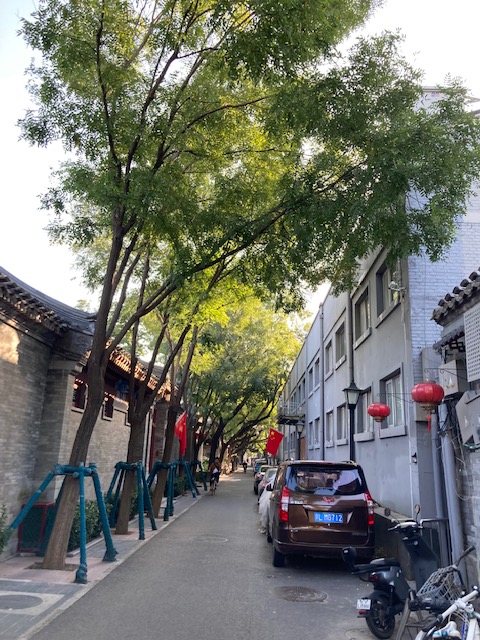
In the Hutongs, life is unrushed, Love how people squat instead of sitting. To play cards, smoke a cigarette or have a chat with a neighbour. I used a squat dunny just now. It was a strange experience years ago and pretty embarrassing to think we had lived our first 20 years barely going near this type of toilet which is or was common in most of the non-western world. But we quickly got used to it and even started to enjoy it. Perhaps not as much on a moving train where things could get a bit hairy and less so in some public toilets without doors where the stench was quite unbearable. The locals like usual were mostly unfazed by things that made us uncomfortable and we were always amazed at blokes who could squat for their morning ablutions while reading the daily news, smoking a cigarette and perhaps conversing with their neighbour.
Midday post-lunch snooze well-needed. In my first job, I used to race home on my bike and cherish the 90-minute break from the chaos where I could zone out and prepare my afternoon classes. When I became more confident in class I could snatch a half-hour nap and return to class refreshed for the afternoon session. In those first six months especially just being outside in the heat and noise and air would exhaust me so that my tiny, relatively uncomfortable apartment was a veritable haven away from it all. Saturday mornings at home were blissful.
After less than 20 hours, I am battling the familiar fatigue of navigating the world here. It isn’t the sheer humanity and traffic and pollution (they are all slightly less intense and quite easily handled, especially with all the EVs and EBs) but the bureaucratic barriers put in place for foreigners. We are just tourists, who come to experience and explore the country, but nothing is easy. Paying by an app on a phone is essential, yet international roaming is expensive and not always reliable. Getting a local SIM card requires a trip to a special place that can sell to foreigners, but then one requires a VPN to access foreign sites that we rely on, yet VPNs are costly and not always reliable. And so the circle goes. The grip tightens.
Public share bikes are everywhere and are ultra useful yet they require me to upload my passport and a photo of me holding my passport next to my face. Then they will approve within three hours, but it took much longer. I was stuck on foot in one of the great bicycle cities. If ever a place can teach one a certain philosophical patience, this is it. Walking/living without the internet is barely possible. Lose battery and you might as well lose your heartbeat. I am in the closed loop of simple daily admin.
I can shake off these frustrations in minutes. I walked some old haunts. South on Jiu Gu Lou Dajie (Old drum tower road) towards the drum tower and left along the awesome and iconic (for me) Gulou dong dajie. Past the old site of Temple, a terrific bar and one-time party institution in that part of the city. Illness Sickness, one of the best bands I was in in Beijing, played one awesome gig there in 2013. Then past the site of Mao Livehouse, also an institution at one stage and a world-class rock club that hosted some amazing local and international bands 4-5 nights a week. We played our first gig there in 2010 at new band night and played three songs that someone recorded and thought we were pretty good. Got a recording of it somewhere. I said ‘This is our first show’ and some random in the crowd said ‘We love it.’ Enough. That club is gone and I couldn’t even find the actual old location.
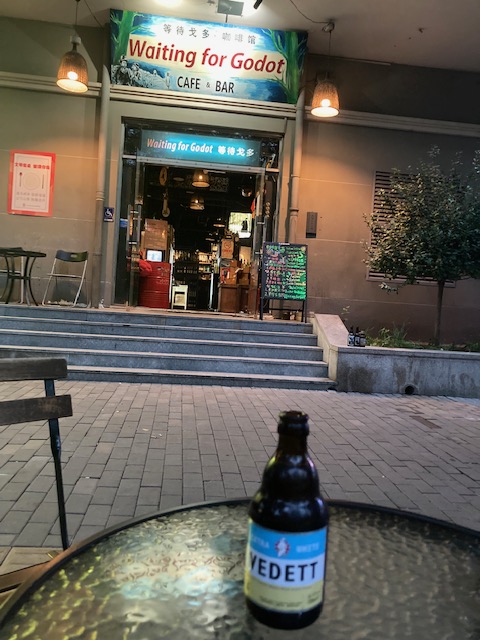
The old memories disappeared physically but Cafe Zara is still here. I can only imagine the persistence and luck required to have survived for the last decade. Remarkable to see things still standing. Then further east to Waiting for Godot cafe. Still alive! Many drunken arvos and nights there for no reason. Vedett x 2. Amazing white beer. I met up with Chris and talked about our impressions of the city so far.
We reminisced about the glory days and I think there was vice and opportunism in the air and on the streets back then. When all of the street food stalls and street sellers have been removed, the atmosphere of the streets naturally changes. The hustlers are gone. Gentrification is great in theory and no doubt a sign of development and increased wealth, and I understand that the government wants cleaner streets, better hygiene, easier regulation, but it detracts from the city experience. In the past, there was much activity in the street, a fair bit of desperation and a great deal of commerce. Now not so much.
You can’t blame the city too much for gentrifying and I’m sure most locals would tell you it’s a good thing. I do feel for the undocumented migrants who worked in so many unregulated industries. Industries that have been mostly eliminated in the central part of the city. Beijing is heading in the direction of other cities, with order and law and civility.
Less smoking on the streets but still pretty common and if you hear a man coughing stand by for the dramatic/gross throat clear and in most cases the spit on the pavement. Still a bit traumatising, and if they managed to get rid of all the street vendors it would be nice if they could stop the spitting.
A beer on the street outside Godot. A slight chill in the air. Summer is over and I can feel that physical nostalgia from when my bones knew that the winter was coming, and quickly. The seasons always changed overnight here. In the long, grey, dry winter, outdoor food and drinks would stop for months and instead of asking for cold beers while eating on the street we would move inside and many restaurants would use the fridge to keep the beers at room temperature and not turn it on.
That’s why the city feels different. Food is ordered and eaten in shops rather than from a person in the street. The street vendors, classic entrepreneurs and self-starters, have gone the way of the underground massage girls/spas. Eliminated. Midnight snacks used to be bought from a bloke who somehow acquired some lamb sticks (frozen) and mantou and some pieces of coal and warm longneck beers and a few stools and tiny tables and in a matter of minutes if he found an accommodating bit of footpath he was his own boss and the owner of an outdoor restaurant, however temporary. On a warm night one imagines he could spin quite a decent profit.
The new gen may never be a part of this street community of late-night eaters, though their stomachs may also never pay the price of a late night of street food the next morning.
But damned be the next day.
Winter sadness in the air now as I shiver.
The aforementioned self-starters were, according to my understanding, often from other cities and had moved to the massive capital in search of opportunity. The ones running street stalls were often poorly educated and didn’t find work in the massive office buildings like so many other migrants. These people lived more precariously, hence their necessity for risk and hard work and self-starting. Precarious as they were without residence rights and legal protection and access to health care etc that an ordinary and lucky Beijinger gets as a birthright. Hard for us Laowai to grasp, as most of us come from countries where citizenship entitles you to work and live equally anywhere in the country. Not here. The cities are hierarchical and a Beijing hukou (residence permit) and the benefits it brings is coveted.
I remember my colleague from the publishing company working there for years. She was a dynamic, short girl from a southern province, with a happy, energetic demeanour. She seemed the type that would thrive in a foreign company or a more modern local company, yet she stayed working at the inert state-owned enterprise. One day I finally asked her why and she told me simply that the Beijing hukou was her goal.
I often found that people were very black-and-white about their goals. ‘Go to a good university’, ‘get a good job’, ‘learn English’ etc were sort of national mantras that most people would copy and pursue without much independent thought. They were the steps to wealth and success and a better life, and rarely challenged.
I was always amazed at how many Chinese people I met in Beijing that were from out of town. At times it was rare to even find a local Beijinger in a group of people. It certainly was the hub for the best students from around the country, especially the more northern cities. If they didn’t come to Beijing to study then a lot of them jumped on a train as soon as they graduated and tried to make it here. That entrepreneurial spirit was one of the key features of my time in the city. Everyone was an ‘agent’ or middleman (person) of some sort and the cost of living was pretty low so it wasn’t hard to stay fed without the security of a monthly wage. If you had a good idea you could print out business cards very cheaply and you were suddenly the new owner of a small business. I didn’t know it at the time, but I took a lot of inspiration personally from that spirit of small business and giving something a try or fake it ‘til you make it or whatever cliche applies best. I credit that spirit with giving me the attitude that led to my own business somehow becoming semi-successful despite no experience in or knowledge of the industry that I started in.
Rain is falling on my page as I write and I will continue walking. A cold beer on the couple of chairs outside Waiting for Godot, one of the world’s weirdest and best cafes, is a true pleasure. Such a dry city. Apart from torrential summer storms that would paralyse traffic and sometimes flood main roads, rain is a surprising occurrence, and this drizzle dies out quickly.
From Waiting for Godot I explored some of the old places I frequented years ago. The local restaurant where we spent hours is now obliterated. We called it Backyards and someone discovered that we could walk there directly by going through a hole in the fence of our compound rather than walking out the main gates. It was a classic place to go down for a quick meal and come back four hours later well fed and drunk. One summer in particular I recall vividly as they were selling Zha pi (draught beer) from mini kegs and a medium size glass was going for about 40 or 60 cents. We drank one after another, yelling across to the waiter for another round. On a hot summer night at an outdoor table, the hours would drift as the locals went about their business. Some poor bloke would be sweating over the thin coal pit built into the wall nonstop cooking chuan (lamb sticks). The no-doubt toxic smoke had nowhere really to go and he was usually armed with a fan or a hair dryer to keep the coals under control. Every couple of minutes he would scurry from his post to deliver delicious lamb sticks to a table and scurry back.
A couple of times I hosted Australian bands in China and I often chose this place for their first meal. I didn’t even let the boys check the menu, just ordered 6-7 of the classic Chinese dishes and a heap of rice and beers and lamb sticks. As a first Beijing experience it was always perfect, such energy in the summer air, noise, constant motion and the intoxicating/toxic mix of city smells. And a great place for a chat.
Backyards restaurant is now a figment of our memories. Like most special places in this world, it has fallen victim to the irresistible power of development and progress. RIP. And yet the Holiland branch round the corner, an evil purveyor of sweet bread, survives, like a rat crawling alive from a nuclear attack.
In my first months in Beijing a couple of decades ago, real bread was hard to find and I hadn’t the wherewithal to find it in Sanlitun, so I was stuck consuming the sweet imitation stuff from the Mei Lian Mei supermarket. I discovered Holiland and thought I was saved, only to be rudely disappointed by their sweet bread, a type of bread I have never since learnt to enjoy.
The Xinjiang restaurant on that street was also gone, replaced by a craft brewery. Craft beer places, usually called Tap Houses here in Beijing, are really common in this cool neighbourhood. This one was pretty empty but had a sign out the front that said ‘People need a way out’.
Other memorable sites were non-existent. Beixinqiao (north Newbridge) subway station had an open square next door with a tiny bridge and it was there that many local retirees would dance of an evening. For all Westerners, the elderly dancing in big groups at night was one of the nicest parts of Beijing and China in general. These daily communal meetings of retired people, either in the morning or after work hours, are something we don’t usually have at home. We often had to navigate through the dancing ayis on the way home from the subway and would smile at their eccentric steps. But now it is gone. The square is home to trees and is dark and soulless and no one is dancing there. There is a small group dancing outside the ICBC bank up the road, though.
I walked south towards Yonghegong. What happened to all the sex shops? Once there were hundreds of these hole-in-the-wall places selling all sorts of paraphernalia. Cafe De La Poste, a fantastic French restaurant and scene of quite a few heavy benders, is now gone. It was the only place in the city where we could find a reasonably-priced steak and great French bread, all coming from a kitchen the size of a toilet cubicle. On a lucky (or unlucky) night, the boss would come around and offer us a shot of some French vodka-type drink – a full bottle with an apple floating inside. The nights he left it on the table usually descended into some type of debauchery or memory loss or both. And a long discussion of how the apple got into the bottle in the first place. One Sunday night groups of girls were dancing on the tables well past midnight and we had to come to terms with our distinct lack of culture as unworldly small-town Australians. Ordering a steak well done was bad enough, eating it in a sandwich with the free bread was a definite cultural insult and faux pas.
I turned left into Fangjia Hutong. Nothing left. Did I imagine it? For 2-3 years it was a cool street and random people were opening bars every few days it seemed. There was a Mexican restaurant, Hot Cat Club (an ok music venue), Cellar Door and a bunch of other places and it was happening. Now just another taphouse off the street and minimal vibe.
Quiet. Wudaoying Hutong was another happening place at one time or another. I looked for food but everything seems like a branch of a crappy chain. The shops on Wudaoying are quiet. No idea how they survive selling junk or nick-nacks or even coffee and making about 100 RMB revenue a day. There must be 20 cafes competing. At least I found a bookstore and bought a book. No local, modest restaurants just selling the good stuff. Chris and I found a place like this in Yonghegong and got a great meal.
We walked back to a music venue that Chris had found online, the ones that we used to go to were mostly gone by now. The bar was ok and had a ‘tap house’ which seems like some sort of new ‘state-sponsored’ fun that has taken off. It was open mic and a couple of kids did some stand-up. Most of it went over my head. One of them was reading jokes from his phone.
What would a newly arrived expat think living in the city now? It’s such a different place. No one is particularly warm or polite so the isolation could be even more extreme. There isn’t a whole lot of coolness about either. Like Chris said, it’s like a party apparatchik has been put in charge of culture and his job was to remove any edge, any foreign influence, or subversive, unique, novel thought or behaviour. Make bars inoperable, strangle them with bureaucracy or just demolish them. Bands too.
After stand-up, a jam session, A couple of kids giving it their best but probably should have stayed practising in the bedroom. And the white bloke playing a few songs with a backing track.
Then Chris played and a guy got up and played some long sax solos. Home to bed. Strange first day.
Thursday 10th
Frustrating morning trying to get access to a rental bike. I’ve heard that China used to be the most popular travel destination in Asia for tourists and I can believe it. At one stage there were flights full coming every hour. The pandemic ended that pretty quickly and the recovery has been slow or non-existent. The country has a very different reputation currently and it’s no longer a destination compared to other Asian countries.
The visa-free travel for Australians is one of the reasons I was inspired to come back, but the ease of entry is offset by the hassles of navigating the world here. I yearn for the days when I could get a sim card in ten minutes and pay only cash. It almost seems like the point is to frustrate the intrepid tourists so much that they simply give up and go home.
Positives. A fantastic, classic blue sky day that made October the best month of the year. Not a cloud in the sky and no grey on the horizon. I found a rooftop in Wudaoying for a coffee.
We talked last night about what a foreigner living in the city, fresh from overseas, would think about this place. Did they take a wrong turn somewhere and end up here, a decade after the end of the glory years? One can only imagine.
The bike rental was representative of my time in the city. Frustration is a regular companion and if you’re tired or of a certain temperament it can break you. I was cynical and frustrated by the time I left and it made my transition back to Aus easy. I didn’t miss it that much.

But usually, the frustration was outweighed by great experiences. I gave up on the bike rental and we used our problem-solving skills – acquired mainly in this city – to seek out a bike repair man. Twenty years ago they sat on every street corner repairing a constant stream of flat tyres or broken chains or other things. One of the beautiful symbols of the city and the bicycle age, the chain-smoking bike repair man – the ultimate problem solver. They were gradually phased out as the population embraced motor vehicles wholeheartedly and rapidly like they do with all new trends. The narrow roads became filled with cars and the bike riders could barely find their way through the dense traffic. Slowly the previously huge bike population disappeared. I was so happy to see the appearance of masses of public share bikes in the major cities 7-8 years ago. Suddenly, people didn’t need their own bikes (often stolen) and could just scan a code and grab a bike for a short, cheap trip and leave it when they arrived. In most cities it was faster than a cab ride. Quickly the streets were filled with young bike riders, like in old times.
I witnessed the widening of a street up close when I was working on Gu Lou Da Jie in 2008. It was a narrow street before, and two lanes were becoming four so that every shop was being destroyed, some of them overnight. I bought a bottle of water one day and went to do the same thing the next morning but the shop was gone, demolished overnight by a team of workers working under floodlights.
I was so overawed by the intensity of the city that I subsisted on a very simple diet. If I found some food that I liked and felt comfortable ordering, I was happy to eat it nearly every day. I found a roujiamo stand near my school and for 2.5 RMB (50 cents) I could grab a delicious Chinese hamburger for lunch. Sometimes two. I was devastated when I visited that place on a weekend and it had disappeared.
As the streets were widened, combustion-engine cars filled them and the car became an essential symbol of middle-class wealth, like in every other modern city. The roads were packed with novice drivers not versed in staying in lanes or following rules, lights or etiquette. Carnage, biblical traffic jams, noise and pollution ensued. Traffic jams became a defining feature of the city like hutongs, smells of delicious food and shocking pollution.
Bikes started to disappear like a native animal under attack from a recently introduced predator. So the repair man disappeared. But a few have survived, through upskilling (fixing electric bikes), or pivoting or diversifying or sheer bloody-minded persistence. Our guy was there on Xiang’er hutong and he has seen much change. He rented me a bike for the rest of the day. Cash was paid and no ID was shown. Deep sigh of relief. Faith in humanity and the capitalist spirit was restored. He was the face of human redemption as I grappled with despair.
My mood swung suddenly and decisively now I was back on two wheels. We rode east to Sanlitun. Through an east-west hutong, all was now well in the world. Sanlitun. How many times has a cab door slammed and someone said ‘Sanlitun, Xie xie.’ Sanlitun, repeated back by the driver with a thick r added to the last syllable for extra Beijing authenticity. And we headed for a few drinks that nine times out of ten descended into a bender. A fair few times a walk back from Sanlitun as the sun came up ridiculously early (4:30 am?) and the early bird locals were out sweeping the streets, using the bathroom or in some cases cooking us jianbings from the back of a tricycle.
Sanlitun was the bar district, the hotbed of vice and home to the best bars. It had taken on many iterations and changed face many times. New bars were constantly being knocked down and others opened. Crackdowns, demolition, relative freedom, new openings, repeat.
But the bulldozers had finally prevailed and the Department of Culture had finished the job as the small district has now changed beyond recognition. Like archaeologists or people returning home after bomb attacks or a natural disaster, we tried to identify the locations of great places from the past and had no real idea where they were.
As nothing good still existed, what was the point of even visiting? Memory lane is a dead end at times. Definitely today. If the place was a construction site or a vast hole of debris, it might have been redeemable. But the scene of our peak years is now a mecca for pointless consumerism. Massive facades of huge stores fronting the names of shite, trite multinational brands, the interiors housing overpriced, fashionless, imaginationless products. We hurried through, spent nothing and emerged on the other side tainted. This is progress. Stand back.
We sat for a coffee where a lady cleared her throat and spat into a tissue every five minutes. In a French cafe!!! The shame. Otherwise, an epic ride back through one of the great bike cities, this time through Hutongs, quiet and mysterious, afternoon autumn sun hinting through the trees.
I had a rest, recharged, then returned the bike and walked west towards Houhai. I then walked west through the narrow, slightly winding hutongs. It is amazing how one can be on an overcrowded, chaotic main street and be steps away from a hidden, quiet neighbourhood of locals and their daily way of life. I was slightly lost but knew my way by instinct. It was quieter now at 5 pm with the school rush finished, the golden hour and the beautiful late afternoon pause as people moved to the next phase of the day.
On the way, I passed Nanluoguxiang, another formative landmark in our Beijing adventures. Unrecognisable now and worth only five minutes of my time. A mosh pit of local tourists stopping for photos or entering the silly shops. We had some of our best times at the Australian bar Neds, one of the smallest bars in the city, and I met some of my best friends there. I couldn’t even find the location of Neds, and once again, what was the point.
I walked to Houhai and somehow emerged on the main road and in front of a famous bridge next to an old post office. I think I sent presents home to Aus at that very post office 20 years ago.
A slow dusk and quiet as I walked clockwise around the lake. Usually, I am so aware of north, east, south and west when in Beijing, but it is refreshing to lose orientation here. Some sellers flogging funny knick knacks but quietly. A few with Tang hu lu, that famous old candy, but I didn’t smell the stinky tou fu which usually confronted tourists in this area in the past.
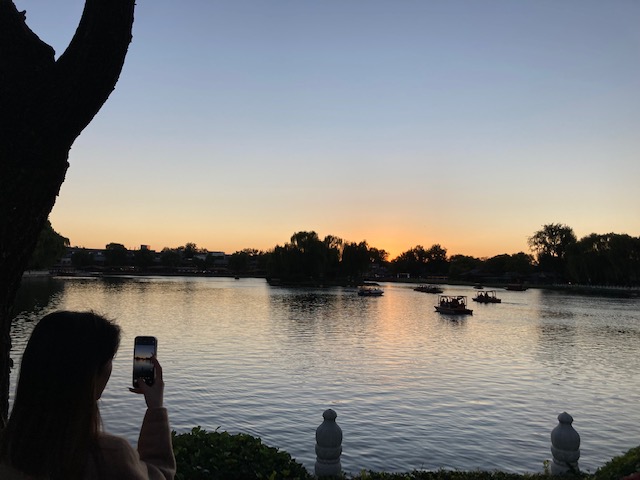
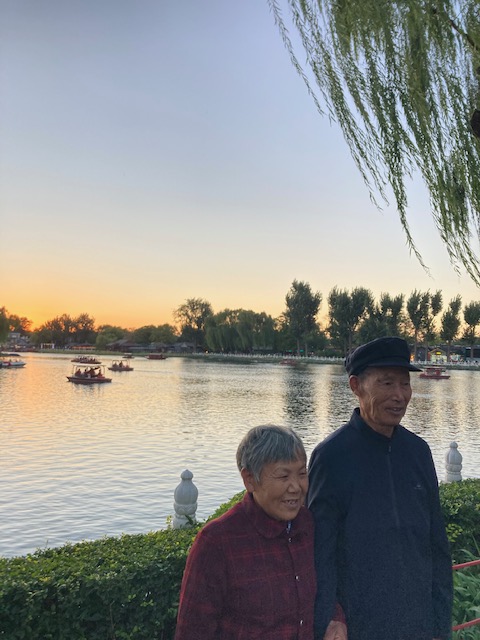
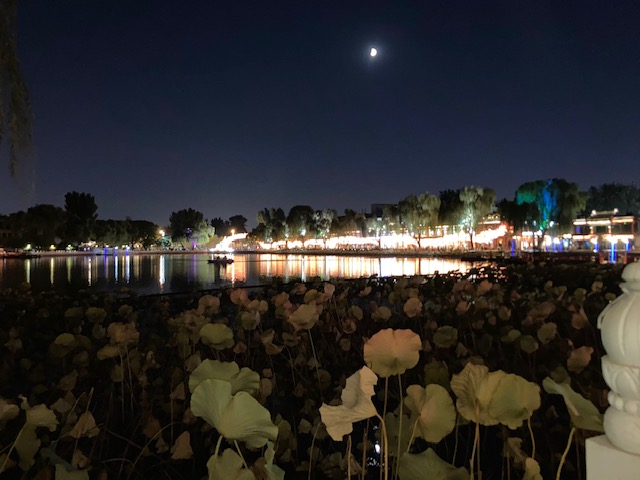
Some brave types were swimming as it darkened and lights began to reflect off the water. Just the chatter of conversation and nothing else. Rare peace.
I had a beer by the lake and slowed down. I remembered my trips here over the years. How I lived close by in the first six months, then moved further away and gravitated back to this mystical part of the ancient city. October ‘04 still resonates in my memory.
The place is pretty much unchanged. It still has a mystical allure. The Eastern beauty from books or movies or stories. Perfect at the tail end of the National Holiday week in spectacular blue sky weather. In a few weeks, an icy wind will blow across the water and the falling temp will turn the lake to ice and the city will become quiet and cold and mean. But Houhai stays beautiful. Almost deserted in the colder months yet even better for sad walks and thoughts or for romance and snatches of privacy in dark corners. I’ve been back in the city less than 48 hours. I’ve walked around nonstop and starting to feel familiar again. This place is in my bones no matter how much it or I change.
Friday 11th
Awesome day at the wall. One learns pretty quickly that Badaling – the most well-known part of the Great Wall – is a disaster as far as the tourist experience goes. It’s a mosh pit of tourists from interstate getting their priceless selfies.
The experience can be a bit frustrating, overwhelmed by humans, noise and salespeople selling disposable crap. Landfill. As always, you just need to be willing to think outside the box a bit and you will be rewarded. With some local knowledge, we found a deserted part of the wall close by. Dilapidated, isolated, blissfully empty. We had driven 90 minutes from the city. We had a steep hike to begin up a rough section of unstable rocks. A perfect blue sky day. Shorts weather and total silence, with no wildlife apart from some black pigs roaming in groups down at the bottom.
We worked up a sweat ascending but there was a cool breeze constant and as always a sign of things to come. It was quite green but we could imagine the brutal winter ahead as all life would be diminished to become a barren, grey, inhospitable countryside. And we imagined those winters centuries ago when men were assigned the job of constructing a part of the wall at a backbreaking and glacial pace.
One can only imagine the diet available in those times. Nothing is growing out here when it gets cold as the earth is so dry. Steep and rocky and grey. Perhaps the one positive back then was that there was no pollution from the city. A lonely, isolated existence. We complained that we couldn’t find a decent coffee out here.
We stopped at a little village at the bottom of the hill. He would prepare us lunch for later. A simple little homestay. We had stayed at similar rustic places like this many times back in the day.
Once a group of us stayed a night a few mere steps from the wall in the middle of a typically brutal winter. The kind hosts served us a veritable banquet in our one massive room and after a huge meal and drinks, we slept about seven of us all in a kang bed. Basically a huge wooden slat with a big empty space beneath. The hosts kept that space filled with burning coal throughout the night, filling it from a hole outside the room, and one’s dreams were informed by the heat below and the bitter subzero air in the room. Great times waking at dawn and walking up to the wall, climbing 400 metres and being totally alone under rare blue skies as the sun rose in the distance.
It was four of us this time. Chris and his French friend Gilles, a talkative, well-informed photographer who has lived in Beijing for close to 20 years. And his friend/colleague Dan Dan who works for a German newspaper/news organisation. Foreign media are pretty much persona non grata these days and they both had lots of interesting observations to share. Chris and I gave our cynical, slightly negative opinions about the state of play in the city and how it stacks up against the glory days. We included the disclaimer that we were here with the main purpose of looking back, reliving and observing change. That was a recipe for disappointment or an empty feeling.
Slowly the part of the wall we were hiking changed from rubble to a renovated version. Our knees sighed in relief, although it was still steep and challenging. Epic pictures and landscape. So lucky to be alone during October, days after the National holiday when the capital is swarmed by tourists.
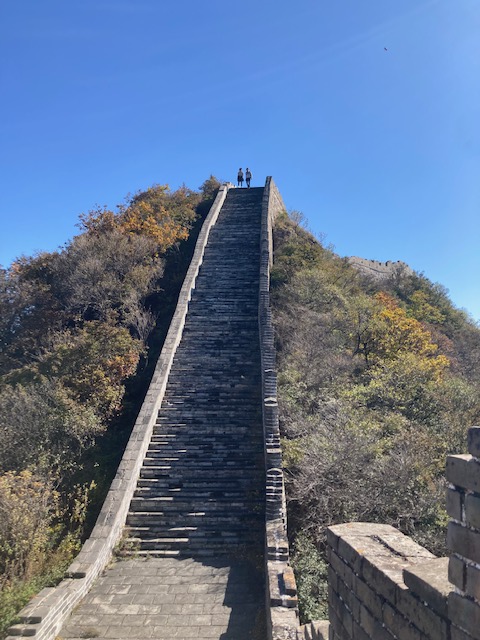
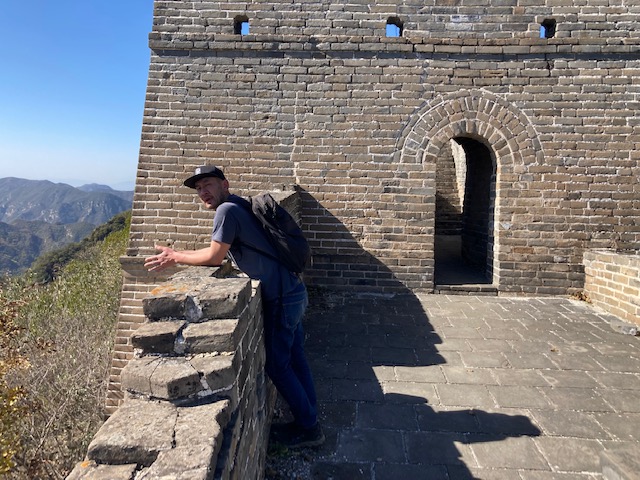
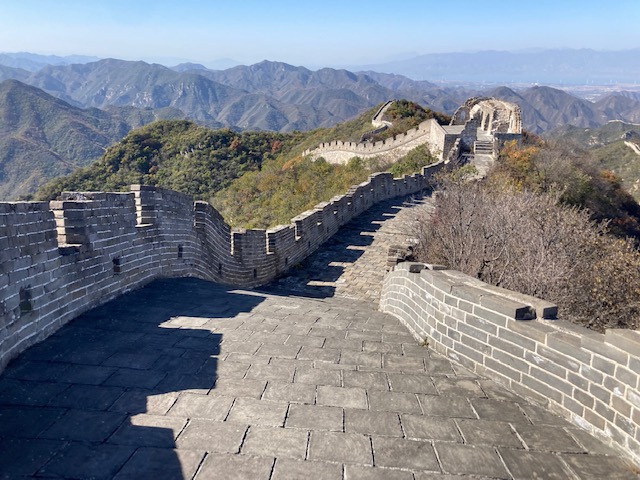

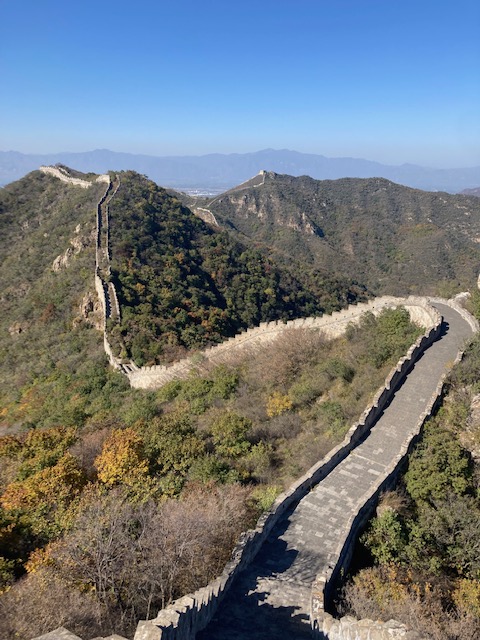

We came back down a tree-lined path and I was reminded of another time when we came up here with food and sleeping bags and plenty of drinks and slept the night in one of the watchtowers. This time it was a challenging 4-5 km loop. We walked back to the guesthouse and had lunch. On the quiet road back, we passed a group of ten or so tall apartment blocks. 8-9 floors each. There were some cranes standing idle and a group of buildings for worker accommodation. All empty. All deserted. The apartment blocks were shells, awaiting a coat of paint and installation of the interior. On the fences outside were pictures of happy, smiling elderly and slogans promoting the retirement community to one day come and live here.
On paper, it might have seemed like a decent project. Under the Great Wall, in a quiet part of the country and not too far from Beijing. It could be a great place to retire and age, despite the harsh winters and stifling, dry summers.
An image of a finished apartment promised luxury. Other infrastructure would no doubt follow once the accomm was ready. But the project has been abandoned, and given the lack of optimism in the air, I can’t see it being finished in the next decade.
The ghost towns and cities are easy to find. On the outskirts of Beijing, alongside highways, along the high-speed train lines, there are thousands of them. Abandoned projects, cancelled dreams. It is perverse because at home we can’t build enough new places for our slowly growing population yet here with a massive population, there is too much accommodation. I have no idea how it all came about, but it is obvious that a lot of these projects were doomed from the beginning, and someone gets rich regardless.
There was always such conviction that real estate and buying one’s own apartment was a certain investment, guaranteed to grow in value and really the only place to put your money. It was like a self-evident truth, like water boiling at 100. And every time a smug economist warned of a bubble, and the apparent bubble defied predictions and just kept growing, well that was further evidence that it would be ok. And for the last few decades, it has been.
When I talked to my students about this years ago, and I speculated that sooner or later the prices of apartments would need to correct themselves and become more closely related to average salaries and living expenses, I was dismissed. The cycle that was pushing prices ever higher now could work in reverse. ‘No, the government would never let that happen.’ And then the inevitable ending to the discussion. ‘You don’t understand China, Tom.’
Alongside these empty buildings, the local community continued their simple existence. Who knows what they thought of the promised prosperity of a retirement village opening soon nearby? More dance partners? A market for entrepreneurs selling snacks? Or what they thought of the abandoned buildings around the corner. What will happen to those buildings in the future? Is it worth knocking them down? Or letting them degrade over the years? Or will someone come along to finish the project?
We sat in the shade and had a delicious country meal with rice and a cold beer and chatted in peace with only the rare noises of country life. A dog corralling pigs somewhere, The chatting of a passing couple or the low hum of an electric vehicle.
We planned our trip back to the capital.
A long Friday night Subway trip back to the city. The subway lines have extended outside of the fifth ring road in a matter of years. Like three aliens, we were the only people on the train – maybe in the whole subway system – not glued to their phones.
As China has become a bit more isolated from the world, so many things happen in the country that I never know about. It has always been a place of rapid change. The new normal takes about a season to become commonplace. The Electric Vehicle revolution is an example. They barely existed when I left, and now every taxi and about half of the private cars are EVs. The local air pollution and street noise have both been greatly reduced, making the city significantly more pleasant. No small feat when you consider the so-called ‘progress’ made in other countries.
Gilles mentioned his plan to photograph for an article about ‘youth retirement villages’. Our ears pricked. Another phenomenon appearing without our knowing? We didn’t live here and we didn’t follow their news assiduously or spend our lives on their apps or even read the language well anymore, so these trends passed us by.
He explained it as best he could and it was confusing. A great story for foreign media and foreign audiences to show the economic decline here. About the only type they publish. Much like the ghost cities and perhaps more resonant than the youth unemployment statistics.
Kids in their 20s are struggling for work. Typically, the first years in the workforce were brutal. Long days, low wages, enslaved to a job. In the past, this lifestyle was expected and to an extent embraced by the country in general. They are nothing if not obsessed with hard work – either doing it or talking about it. Work hard and build the nation and put your feet on the ladder to your own prosperity was the basic expectation.
Yet if jobs are hard to find and salaries are low, why embrace this world? Why bother? Things will no doubt improve, but a small group has decided to give up the battle before it has really begun. This type of disillusionment and withdrawal from society is unwelcome.
So these kids go into a country area and set up their own activities outside the rat race. A place to relax and take it slow, where it is cheap and far from the intense, overcrowded and competitive cities. This is a youth retirement community as we understand it.
Living an alternative life and encouraging others to do the same as a youth in a sensitive
ultra-conformist culture sounds a bit subversive in the current atmosphere.
A quick visit to School Bar – one of the last punk clubs – and a few beers before bed.
Saturday 12th
I have been accepted by the share bike app and now have access to the green bikes. In this part of the city a bike is only ever 30 metres away. Freedom. I looked for a bakery that Gilles had recommended but no luck. But I found a cool upstairs cafe on Gulou Dong Dajie. The young girls here are obsessed with taking photos of each other in public. Da Ka they call it. A cafe needs to present itself with this in mind. If you can design your space in a certain cool way, you can rely on the constant stream of guests there to pose for and take pictures. They will buy a coffee as a sort of permission to spend an hour or two in this pursuit. Paying a real-life influencer to come to your cafe and take and then post pictures is no doubt essential marketing spend too. I sat with my notebook as they hovered around, posing for photos in front of the faux-ancient design on the rooftop.
I rode south from there towards the city’s major landmarks. Past Houhai and Beihai and Jingshan Park, slowly lost. In the first few months I lived here, I didn’t dare have the courage to visit these intimidating places alone. I stuck to my little neighbourhood, and it was a couple of months before I explored further. I had been warned against visiting Tiananmen Square during the national week as the lines were long and ID was required. Cops and police vans were at every intersection. There was a noticeable increase in police presence compared to my memory. I wasn’t ready for the waves of humanity and the massive open spaces around Beijing’s bucket-list monoliths. Massive and all a bit soulless for me. Domestic tourists are everywhere. They may travel abroad a bit less, but tourism by Chinese to Beijing is still booming.
I kept moving, heading further south and then east to Ritan park. Then through the one-time Russian district and back towards Sanlitun. The magnificent blue skies of yesterday were now tinged with a familiar grey and I could sense a few days of smog coming. I knew the trend well. Look directly up and the sky was blue, but the real test was to look at the horizon.
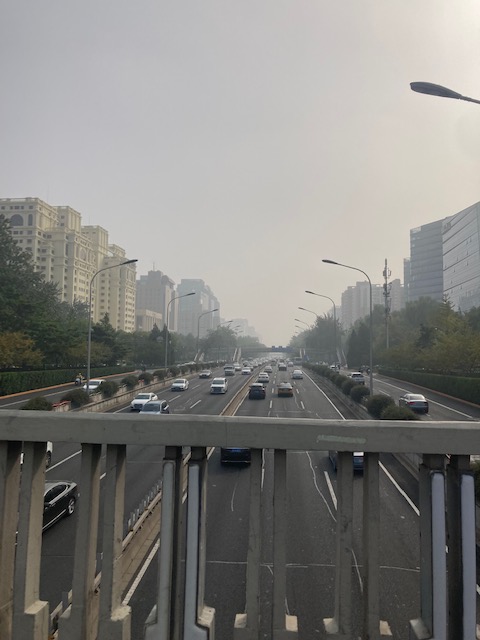
I ended up at Great Leap Brewery, another survivor. From there we went to Paddy O’Sheas, another stalwart and a bit of a shithole really. Somehow it has outlived its competitors, maybe because of its location near a few embassies. Here we met up with a few expats there for a Saturday night drink. It was a Saturday but a work day. One of those curious things that often confused us, to give the population a long break of five or seven days of holiday but make everyone work a couple of days extra before or after so that they only really get one official public holiday. At least that way the worker population knew they had a certain period of time to jump on a train for a holiday or, at New Year, a trip back home to see family. The train stations were usually overwhelmed at the beginning and end of these holiday periods, and tickets were in high demand.
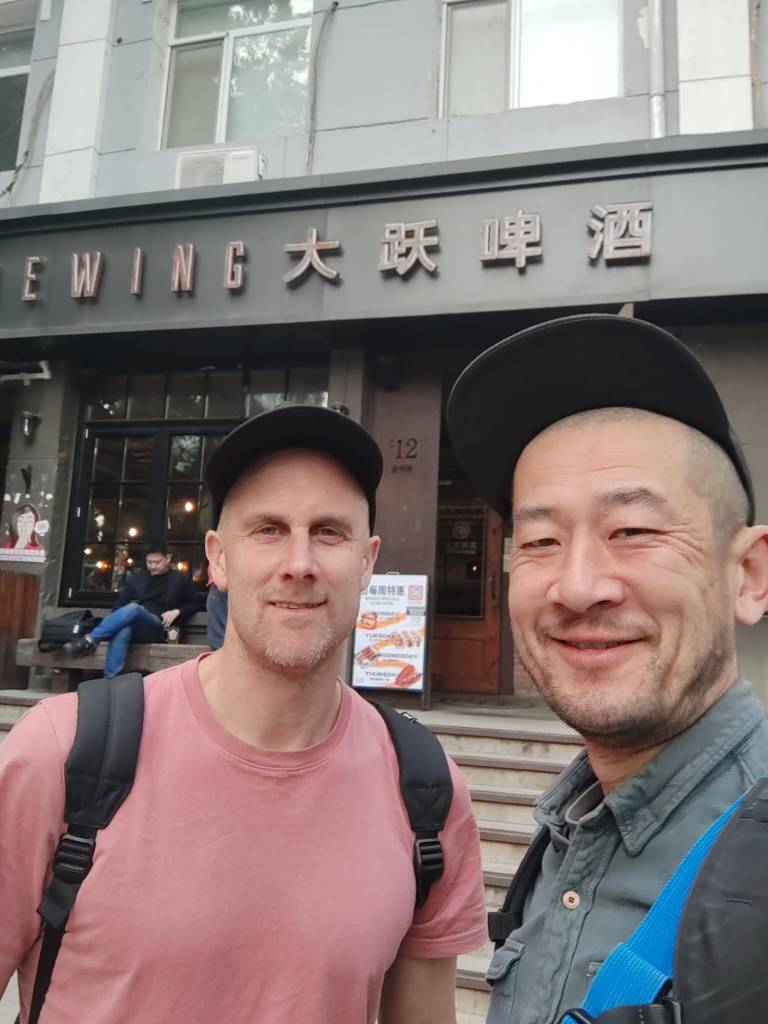
Being at Paddy O’Sheas reminded me a bit of when I lived in Tianjin. There wasn’t much of an expat crowd there, so one needed to make friends with whoever one met. There weren’t many great options for parties so it was a couple of bars and clubs on rotation. Tianjin is a ‘second-tier city’, still ginormous in terms of population, but less developed and fifteen years ago it had a much more ‘local’ vibe. Chris and I commented that Beijing, now with less lustre than before, reminded us of a ‘second-tier city’ – a bit more provincial, despite its incredible modernity and recent progress. We had to hold our condescension in check though, as we were surrounded by blokes who were still living here, and they probably weren’t keen to hear stories about the glory days.
We had a few more drinks. It was always an amazing place for Saturday afternoon drinking – walking from one bar to another half-drunk in the fading daylight before heading for dinner somewhere and a few more beers, while the streets were packed with the activity of thousands of locals going about their weekend business.
We rode back west along Gui Jie (Ghost Street), another epic Beijing landmark, the scene of many a Beijing Duck banquet and various ultra-spicy group meals. On weekends most of the restaurants were packed and locals lined up out the front of the most popular ones chewing on and spitting banana seeds. One summer there was a sudden craze for Xiao Long Xia, tiny lobsters or yabbies as we would call them and it was like the whole population of the city had decided to congregate and eat these ok-tasting things on Gui Jie. They were always mad for certain fads that seemed to take off instantly and disappear a few months later when the season changed.
It is the best city in the world for riding at night as the temperature drops after a warm day.
A rock club the size of a bedroom hidden somehow a few steps from the Forbidden City in the ancient neighbourhood where everyone still had to leave their house to use the public bathroom. The bar didn’t have a toilet so you could hear bands playing while taking a piss over the road. Was that place even real? The vocalist of each band suffered the electric shocks of the microphone and can still feel the tingles. There’s the proof. The lady running the bar somehow trying to sell tickets (after she had let everyone just walk in!) and drinks but on a hot night most people would just stand out the front and watch the band through the window and buy beers from the shop next door to save cash. No bother. So you play for free or leave with $5 each. Maybe $10. A stage big enough for drums and one guitarist and maybe a vocalist and the rest would set up on the floor amongst the crowd. Stand on a chair if you want to see. All the gear is broken every single night.
At night, the massive landmarks would be quiet. On a hot Friday night, the relentless city was exhausted and we could stream through the heat to cool down on the bikes and around every corner was something new or ancient.
Chris and I visited his friend’s bar, hidden behind a curtain metres from the Drum Tower. There was a decent Saturday night crowd and we had a last drink and I rode back through the almost silent hutongs.
Sunday 13th
Chris and I met up with Xiao Nan for a coffee and a long chat. I realised that after all these years I only have two Chinese friends left. One day I was at home in my small apartment and got a call from a friend who said her friends were looking for a bass player. I had played in various bands of average quality in the awesome, burgeoning Beijing rock scene, but I was apprehensive. I had no excuse, sitting at home on a weekday basically unemployed and aimless in my late 20s. These guys happened to be jamming at a space five minutes walk away, so I went down and had a look, and they were good. Xiao Nan and Xu Sen had both recently returned from living in England and they were cool, confident, international guys. More and more common in modern Beijing. For the next few months we jammed for hours at a time as a three-piece heavy instrumental band before finally playing a gig. Illness Sickness was born.
Xiao Nan has done a lot of music since. After years as a guitarist with a distinctive personal style, he had not touched a guitar in three years and now produced heavy electro music in his massive basement studio. We were keen to get his take on the music/cultural scene and knew he would have a lot of strong opinions. The dive bars where a band could easily play lots of shitty gigs are all pretty much gone. In our first few months as an unknown band we played at about eight different venues in Beijing, only two of them semi-decent, but at that time every second bar was trying its luck as a ‘livehouse’ and you could get a gig with a text message and a band name. Now the tiny bars with practice amps have gone and there are a bunch of bigger rock clubs where bigger bands play and make decent money, apparently. But he doesn’t follow or rate any of those bands. I’ve lost track of the big Chinese bands, and we get no coverage of them online in our music media.
Xiao Nan held court in rapid-fire Mandarin with a scattering of English words and swear words in both languages for effect, and somehow after I had barely spoken a word of Mandarin for a decade, I was able to speak pretty well. Well enough to hold a long conversation and lecture Xiao Nan on certain topics when required. One thing about languages is I often found that if you meet someone and start in a certain language you tend to use that language together forever. My mandarin was at its peak when we spent hours jamming in the dark room.
His opinions were passionately explained and typically nihilistic. The music industry is gone. No one can play an instrument and any idiot who can strum a chord thinks they are a guitarist. No one values practice and skill.
Consumers are idiots. They want shitty, formulaic two-minute songs. Everyone thinks they are a creator or a performer and no one cares about or even acknowledges the great guitarists and musicians that spent years practising. He was not beyond cynicism himself, telling us he needed to get a hot girl to play bass in his band to make them more popular. Even though she could barely play.
It was a dystopian and pessimistic description of the music scene and art in general, not short of mass generalisations and huge exaggerations. He painted a pretty dark picture of the country in general, saying things like ‘China is preparing for war now’ and ‘China doesn’t need foreigners anymore. We are powerful and successful. That’s why you don’t feel welcome here.’ The male authority figure always loved to lecture and hold court in a room here, his voice growing louder and more dominant, and one needed to take his emphatic musings with a large grain of salt. As Chris and I did.
The irony is that this posture of power and overconfidence and disdain for Western culture (and Japan and Korea when convenient) is happening at the same time as China’s economy, one of the all-important features of national pride, is struggling. Hard to tell the next generation how great and powerful the country is when they can barely find a good job to have hope for the future. But reality and messaging never needed to be that close.
A very entertaining guy and a great friend. He can parrot the party line but when challenged he is smart enough to know that most of it is bullshit and propaganda.
Luckily we moved on to other topics. We talked about Nashville, where genius musicians are everywhere, devoted to their art. Then about Nick Cave, a lifelong creator. Me getting sick. Moving to Europe (him). Being a musician. The problem with guitar as an instrument. His obsession with gear and technology, my preference for simplicity. An acoustic guitar and a music stand.

I walked back inspired, surprised that my Mandarin could survive as it has after all these years. There was a time when I spoke it most of the time – at work, at home, with friends, at band practice. And those years have made it habitual, so it was still hidden there after so long, ready to be dusted off.
The pollution was more intense. A storm appeared in the late afternoon and it rained hard for 30 minutes in that weird, unnatural way it has. The familiar grey horizon and the late sun trying and failing to break through, the grey light a defining feature of my memory of the city. After dinner I walked to Ditan Park. It was eerie and almost deserted in the darkness apart from the odd jogger or the ghost-like image of a walker in the distance. And beautiful. There are buildings scattered around the park and they all looked the same, like haunted houses in the sad grey darkness after the rain.

The quiet evenings here are priceless. The rain had driven people inside, and it was a perfect moment to explore the old park and nearby neighbourhood. I’m coming to the end of my days in Beijing and it feels like the tying up of a loose end. I know I might not ever feel the need to visit again and I’m ok with that.
Monday 14th
A thick grey out the window. My last day here. I did come back here to relive my time here and the thick smog was a key feature so I can’t really complain about its reappearance after 2-3 blue-sky days earlier in the week.
I went for a slow jog in Ditan park. The holiday is over and it’s back to normal transmission. Factory settings. Was nice to sweat a bit after a Tsingtao-heavy five days. Ditan Park was busy. If the youth of the country is struggling for optimism, the elderly are living their best lives. They retire early and a lot of them look after grandkids, but the rest have plenty of spare time and spend a lot of it in various group exercises at the park. The gym area was packed and alongside it were people dancing, others doing Chinese hacky sack very skilfully and further away a few groups doing Tai Chi. A great way to start the day and a healthy vibe despite the looming grey fog.
Strolling through a magic park like Ditan and seeing people exercise in their Chinese way or a few solitary practicers of instruments was always an entertaining insight into the culture and the ordinary lives of the people. Priceless stuff. A few smiles from the other walkers.
A quiet last day in Beijing. It’s the closure I looked for when coming back. After all the years away, and the changes in the face of the city and the feeling in the air and the changes in me, I was happy to be able to come back and turn the page, so to speak.
That afternoon I rode over to Liangmahe, a river that used to trickle between the second and third ring road. There was a boat which could be booked for parties there and my first Beijing band, You Mei You, a dirty and pretty average old school punk band, played a halloween party for the football club’s annual party. It was a wild spot. I also once found myself at an Abba night there, where the crowd watched some Abba musical and sang along to each tune. Very strange.
Liangmehe has been renovated and cleaned and filled with water. There are boats and stand up paddle boards for hire and there was even a brave man swimming through the middle. A suitable symbol of the gentrification of the city.
After dinner I rode slowly back to the old neighbourhood, lost as I tried to weave through a few unfamiliar streets. When I finally found my way, a nice last ride heading west. A few classic dishes and a cold Yanjing beer. A quiet end to the week.
‘You keep changing the shape of your face’ was one of our lyrics from a short-lived band called Brave Face. Constant change, development, progress, knocking down, rebuilding. Reinvention. These are the truths of the city, yet how do they exist in harmony with the preservation and protection of the sacred ancient culture and architecture? Those paradoxes are what makes it so special.
 Dark Dirt