Tuesday 15th October 2024
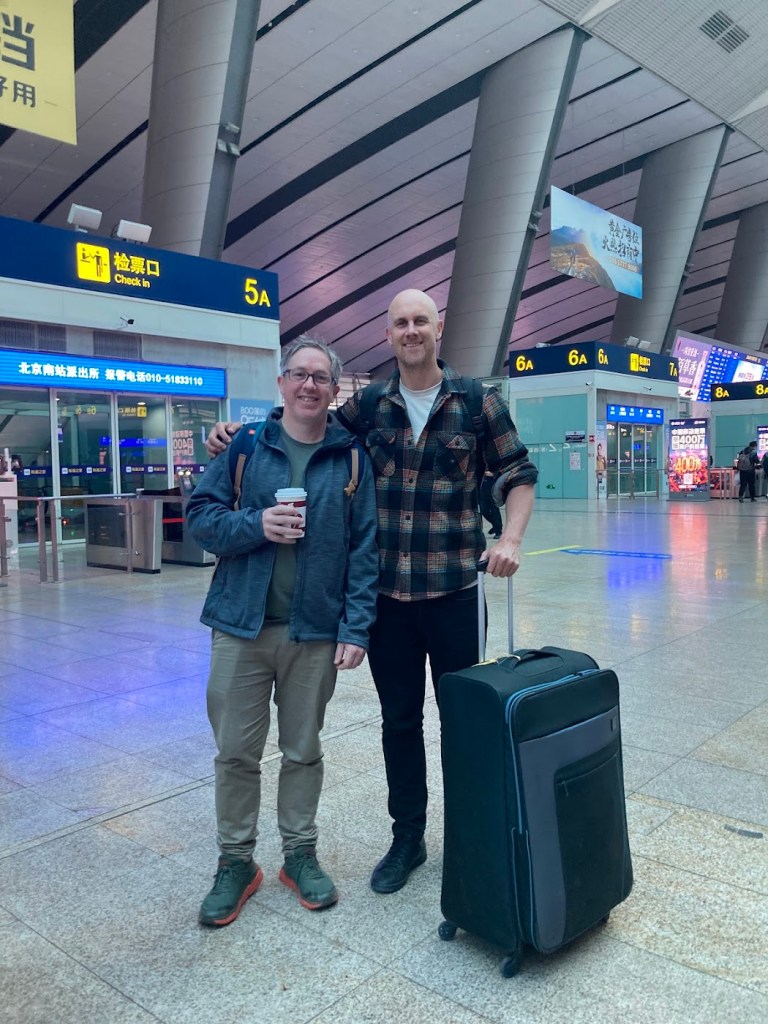
6:30 am departure. Subway to Beijing South Station. As always, great to be back on the road. The subway was busy but the trip was seamless, the public transport mind-blowingly efficient. The train station is mammoth, busy, spacious and surprisingly orderly. Beijing South is clean and modern, vastly different to Beijing Zhan, the original central station that I first visited in 2004.
Different is not a strong enough word. It was total chaos back then. Waves of people. When those books I read in history class referred to the masses, this is what they meant. Thousands of humans with their angst and intensity. Even getting into the station was intense. Obtaining a ticket was next level. In the early days, lining up for a ticket at the train station was like an extreme sport, requiring extreme focus, near 360 degree vision and a willingness to use body contact when needed. Right flank, left flank, the masses unapologetically stepped in front at any time. Back then, I was nervous and overwhelmed, preparing the destination name in my head, repeating it over and over with the date, time, train number and type of ticket (options: hard seat; soft seat; hard bed for overnight journeys; soft bed if you had cash which I never did; standing room for desperate times or when tickets were exhausted).
Towards the front of the queue, more people came from the sides to jump in front. When I somehow got to the counter and prepared to say my sentence, from left and right humans appeared and fired off their destination. The girl served them, barely looked up, took cash, and printed the ticket in a matter of seconds with extreme efficiency and practised boredom. I waited, captive to my poor language skills but more so to my useless western manners and lack of killer instinct. One day patience would prevail and I would walk away with the tiny ticket in my hand, elated.
Years later I would simply elbow them, tell them to move off, and yell the required info with a well-practised tone of aggression and decisiveness. Potential line-jumpers observed me with curiosity and what I interpreted as blankness hiding respect.
But before, Beijing Zhan was a psychological battle and a deep cultural experience. It hummed with life, anticipation and, of course, desperation. It was the final landing point for thousands of migrants and their flimsy, massive bags full of life’s possessions. These people, often unmistakably fresh from the farm, saw me and stopped to stare with undaunted curiosity. Transfixed. In their first hours in the capital – modern like stepping decades into the future – they were no doubt exploited by the ruthless groups of locals and more experienced migrants who hovered in the ginormous outer station square offering tickets, cheap accommodation, food, dubious massages, fapiaos, etc etc.
Inside the station, people filled every nook, slumped on bags, asleep or staring, wide-eyed or exhausted. At least not consumed by their phones. Every food seemed available: sausages on sticks (eat at your own risk), dumplings, chuan (lamb sticks), sweet corn, not-so-sweet corn, various noodles and countless other things. One can not forget a classic train delicacy: chicken feet preserved in plastic to be unwrapped on the train for other passengers’ olfactory pleasure. Cold beer, warm beer, and small bottles of highly intoxicating baijiu (rice wine) if that’s your thing. And smells, smells, smells of course. Food, train-soaked humanity, and if you dared approach, the toilets (either learn the characters 厕所 or follow the odour). A priceless cultural experience requiring great fortitude that will leave an indelible mark on your psyche and a vivid, unshakeable memory. If you seek privacy, walk on or hold it in. The toilets on the train are just as treacherous so it’s now or never.
Train announcement and the manic rush of elbows and arms and swinging luggage to descend. Tense moments as the train appears in the distance and seconds later glides to a halt on your platform and the mammoth machine exhales exhausted and prepares for the next leg. The platform air hums with an anticipation that no airport has ever provided. Then the final drag of a cigarette, a spit, the panicked boarding and a search for your seat. When you find it, place your bags above and sit, you have made it. Take a deep breath.
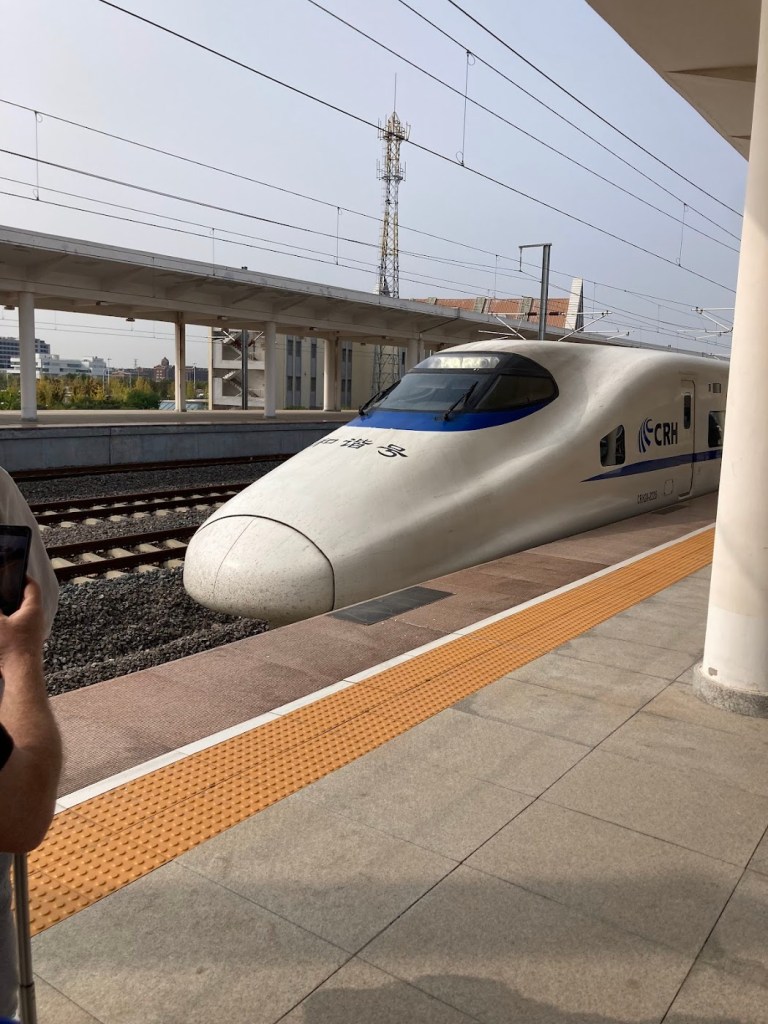
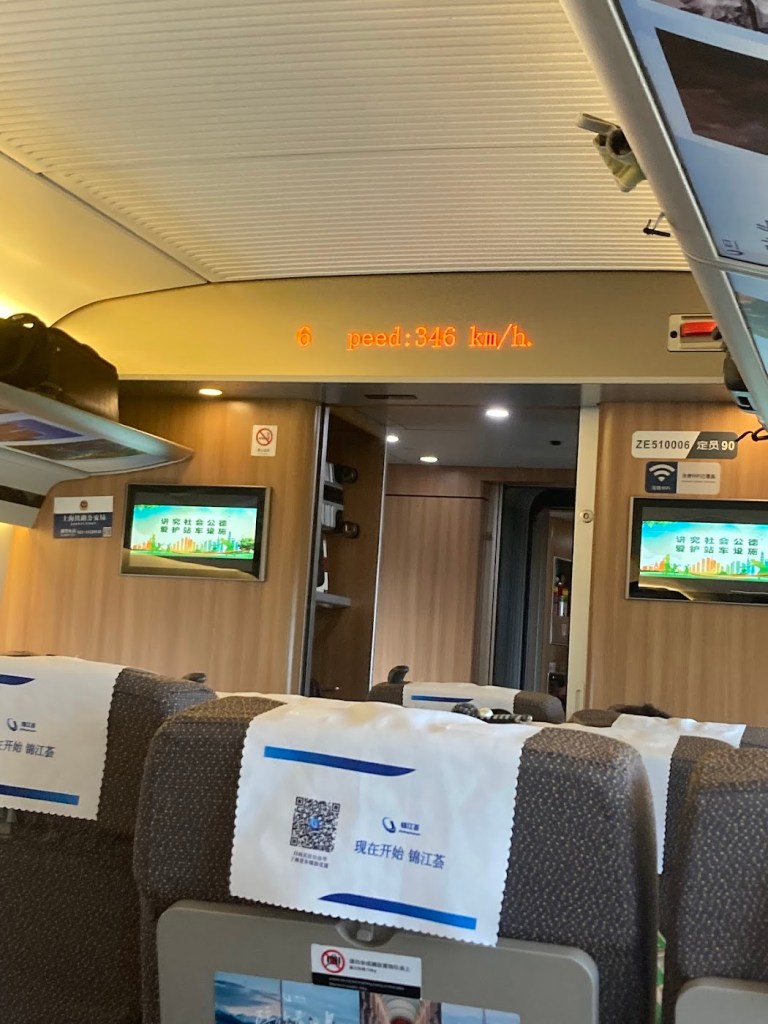
Back to 2024 and Beijing South Station is positively space age as people sit on comfortable massage chairs and stare at tiny hand machines that provide infinite entertainment/distraction. They will soon embark on their journey on a brilliant, slick, unfathomably punctual and fast high-speed train. Progress! Remarkable progress. A train ticket starting with G = gao tie = fast train and speeds of up to 350 km/hr. With a Costa Coffee in hand and tickets easily acquired through an app, we boarded smoothly and the memory of the carnage of Beijing Zhan in 2004 was barely believable. Cherished nonetheless.
Steve and I headed to Jiaozhou Bei Station to meet one of our suppliers. Manning met us at the station. I had first messaged her about ten years ago and have sent her tens of thousands of Wechat messages since. A long and prosperous partnership, growing year by year. Full of misunderstandings and frustration of course. English to be polite, Mandarin when required for criticism (by me) and long explanations, obfuscation and excuses (by both of us). We had never met face to face despite significant sums of money changing hands (digitally) over the years. And I knew next to nothing about her.
From the station we drove to Ligezhuang village, where the hat factory was located. Like in most countries, the rural areas and the towns close by are vastly different to the major cities and it was always a refreshing experience to jump on a train and go somewhere random out in a distant province. Manning was talkative and cheerful, all of us laughing about finally meeting after so long. Her English was pretty good too.
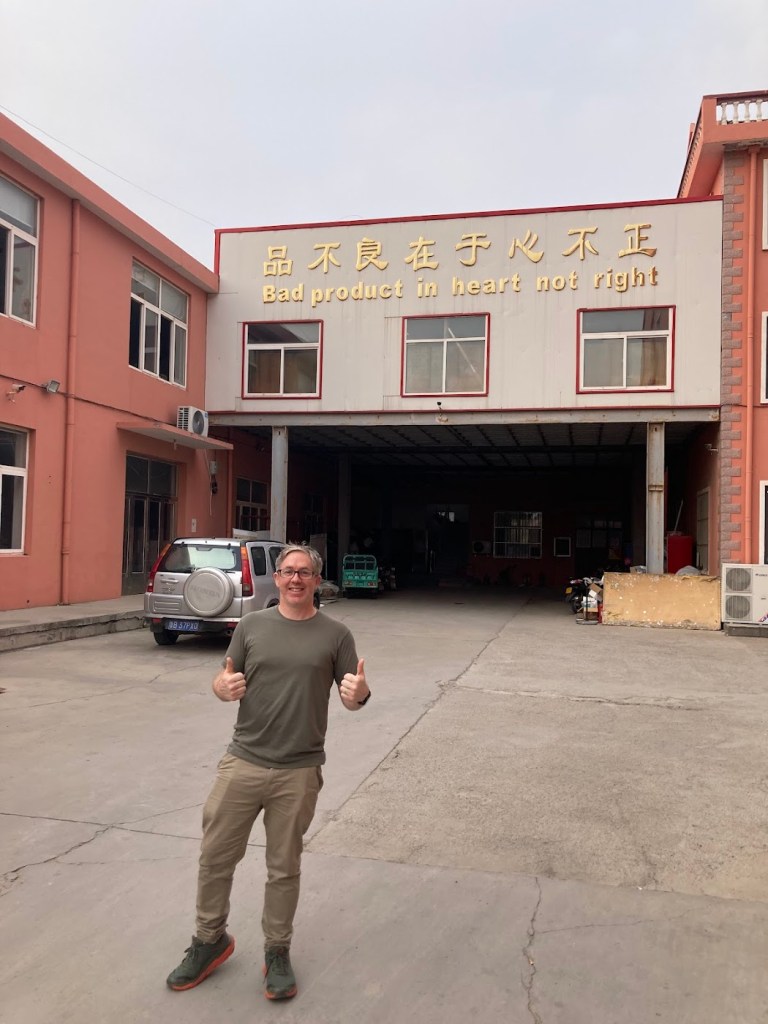
We had no idea what to expect at the factory. It was three or four buildings of four stories each. A decent sized operation, staffed mainly by older local folk working certain machines or sewing or doing something. The pace looked quite leisurely. Was good to see lots of our orders lying around amongst stacks of well-known international brand names.
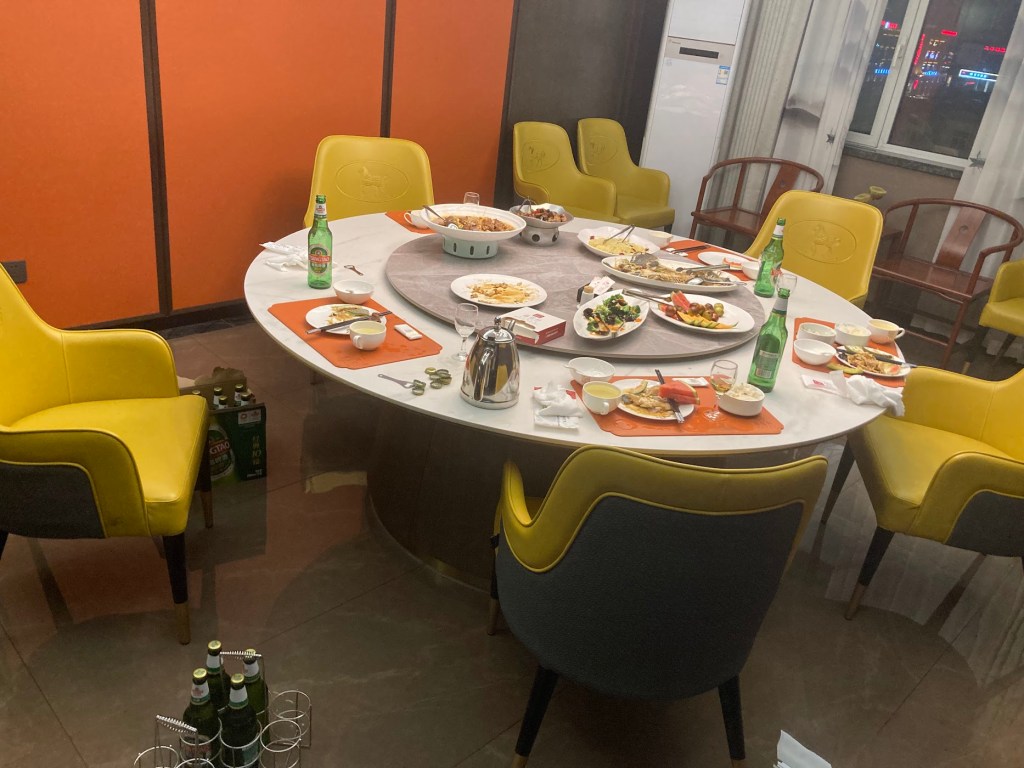
We drove back to our hotel, the biggest and best in the small city of Jiaozhou. Dinner in the private room at the hotel with Manning and her husband. He was a heavy pisshead predictably bullying us to drink at high speeds. I always found it slightly harder to follow the Mandarin of a man than a woman, especially far from the capital where strong accents, slang, dialects and alcohol come into play. The hosting culture in China is ingrained. Always a big private room in a hotel and a huge table although there were just four of us. Order enough food for ten people of course, constant toasts and pressure to gan (finish) your drink.
Long chats about life back in Aus and business and life here in Jiaozhou. My Mandarin surprisingly fluent. Rarely forgetting words and handling every topic quite smoothly. Manning’s husband urged us on and proudly kept count of how many beers he had drunk. A strange and reckless part of the culture and somehow an essential way of hosting and showing respect, this habit of making the guest feel a bit uncomfortable and a bit awkward. Steve and I had survived many of these banquets over the years and knew to NOT get caught shooting the dreaded baijiu (rice wine). Those nights usually led to much regret and biblical hangovers down at breakfast the next morning. Manning was a great host, urging us to eat more of course, and a very funny and lively person, and as the beers kicked in I did get a chance to make one of those sincere, emphatic speeches about how happy we were to visit and keep doing business in the future. Etc etc. I had seen these speeches from the leading male at the banquet numerous times and what mine lacked in linguistic eloquence was made up for in sincerity.
The dinner finished suddenly in the slightly awkward Chinese way. Manning’s husband won the beer-drinking sprint but his quick departure and reddening face suggested he would lose the marathon. I can see how impressive it is for a woman to be successful in business here. In many workplaces females are valued and in general they are expected to study and work hard in society, but in business and politics the leaders are mostly men. They benefit from the drinking and partying boys atmosphere in which females rarely intrude. Manning brought her husband to drink with us and make us feel welcome and 4-5 longnecks and no baijiu was definitely a bullet dodged.
Wednesday 16th.
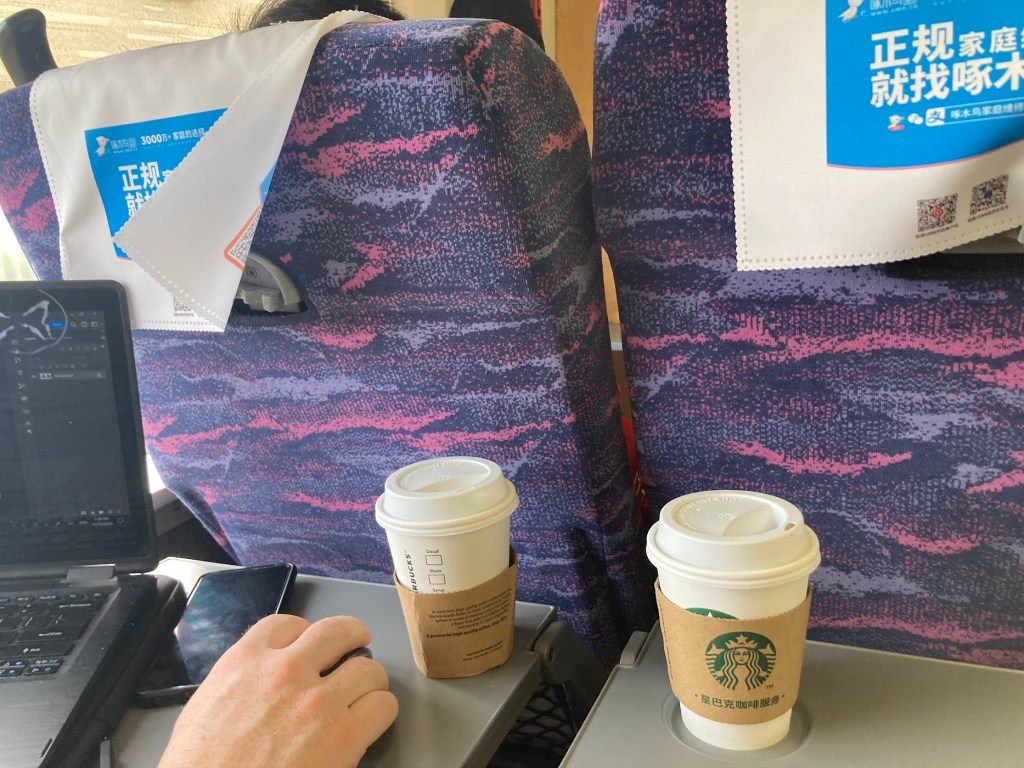
Breakfast, coffee and drive to the train station for the train from Jiaozhou Bei to Lianyungang. Awesome train and a polite kid delivered us a Starbucks coffee each to our seats. Unheard of!
Looking out the train window at the world in a different country. One of life’s great pleasures. Masses of industry. Empty blocks of high rise apartment buildings. Smoke stacks. Farmland, rivers. A massive solar farm that sped by for what seemed like a minute. Grey sky. Dense fog.

We joked about moving to Ligezhuang or a similar small village and living the factory life. Would be bearable for us I guess but a tough experience for a fresh foreigner maybe.
We did love seeing the factory in action. The animosity and thawing relations between the two countries leads to much misunderstanding and prejudice and seeing the factory helped us to see the human side of how it all works. It is a complicated process and the workers are skilful and patient and doing repetitive tasks. We buy the cheap stuff that they make and complain about quality or small mistakes but we know nothing about the process of producing these things. It’s humbling and slightly embarrassing to realise that and appreciate the machinery and expertise of it all.
Train is the best type of travel. It is quiet at first but soon there is a steady hum of pointless noise. One guy next to us receives his stream of messages through regular beeps as behind us a lady yells into her phone and we all hear both sides of the conversation as she leaves the speaker on but keeps the phone to her ear. A row back an old man roars as he snores the reliable rhythm section slowly building to a chorus. The others sit peacefully slumped asleep or lost in phone. Men clear their throats loudly and prepare to spit, the reliable soundtrack of the country. Mercifully they don’t. Another bloke yawns dramatically and another plays music from his phone for the carriage’s pleasure.
The people’s tolerance for these annoyances is almost infinite and no one says anything. At this point the boy offered and delivered us a coffee, surprising us with manners, a smile, and delicious Starbucks which I ordinarily disdain. He was sent from above to calm us as other trains had no such option.
At around 11 the girl took orders for food and half an hour later the carriage exploded into a hum of activity as eating time was upon us. Well prepared all, no surprise given all the options at the spectacular gaotie train stations. A steady noise of unwrapping and eating ensued. Prepared meals, chicken, dumplings, rice, various snacks etc. And the accompanying mix of smells. In this country the soundtrack is always accompanied by the smell track, a constant reminder to your senses that the world’s odours are like noises, indeed infinite. The clean toilets emit no odour, which is remarkable given my past train toilet memories. A great experience all round.
At Lianyungang station, we were met by Cathleen, the owner of another factory we have used for a few years. Another semi stranger who I have exchanged countless messages with. After a quick meal we drove to Shuyang, a small place of two million but still not big enough to be considered a city. A long 90 minute drive past an epic smoky power plant in the middle of Lianyungang city. Once again, we are staying at the best hotel in town in a splendid room where everything is electric/digital. Just don’t even try to carry your own luggage! We have ten minutes to ‘rest’ and then back into the car to Cathleen’s factory.
She is a very ‘discreet’ person, quiet and reluctant to share information. In my experience, communication with her has often been a bit difficult. But to her credit, she is a self-starter. She had never shared much about her backstory, but four years ago she opened her own very small factory and bought some machinery. She had worked in the industry before but she didn’t even know how to use the machines properly. She quickly learned how to use the knit machine and embroidery machine with the help of video chat guidance from the people who sold them to her.
The factory is tiny but humming along and she is the boss and oversees every little detail from start to finish. Her brother works there and her mum is in the corner sewing on the pom poms and packing the beanies in bags. A real family business. A bit of a mess but producing great products for us.
Dinner is another funny cultural experience. A bloke has been assigned as the talker/drinker. It might seem essential to have some male company but it really isn’t. Cathleen barely speaks but her brother and his wife are nice, gentle, funny people. The other bloke is a relative or friend (we missed that info) and he drinks fast and loves lecturing us and cuts me off mid sentence with inane comments.
Nice enough guy, but feels the need to lecture us about China. Zai Zhongguo (在中国) ‘in China’ is a pretty boring start to a sentence especially when followed by emphatic explanations of stereotypes or generalisations which are often completely wrong. Some folk feel the need to lecture us about their country, but beware, the views are not necessarily grounded in reality. I imagine an Australian person hosting foreign guests and holding court and telling them all about Australia and its myths and stereotypes which are not really even true – mateship, equality, fairness etc, true to an extent but sometimes not and at least up for discussion.
Some adamant opinions from our guy: In China, people work hard and love to work hard goes the myth. They do work hard but not they don’t necessarily love it. Chinese people chi ku (吃苦) which means they ‘eat bitterness’ or readily/happily suffer. Well, in the past they had to, but one could argue that the modern youth doesn’t know how to anymore. Isn’t that what the president says? So there goes that national myth. What about if your business fails because of geopolitics or outside forces? I ponder. No, he tells us, Chinese people can adapt, and go back to the farms. Most people here in Shuyang are 1-2 generations removed from small family plots close by, but they are also very urban folk, phone-dependent like all of us. I don’t see them willingly returning to a rural life. It is myth-making in real time, the national traits repeated enough to become national truths and undeniable.
Otherwise another great dinner. Many more beers and excellent food, with Steve under pressure to eat great amounts as everyone else relaxed and stopped eating yet urged him to keep going. Bring your appetite. Another early and quite sudden finish.
Thursday 17th
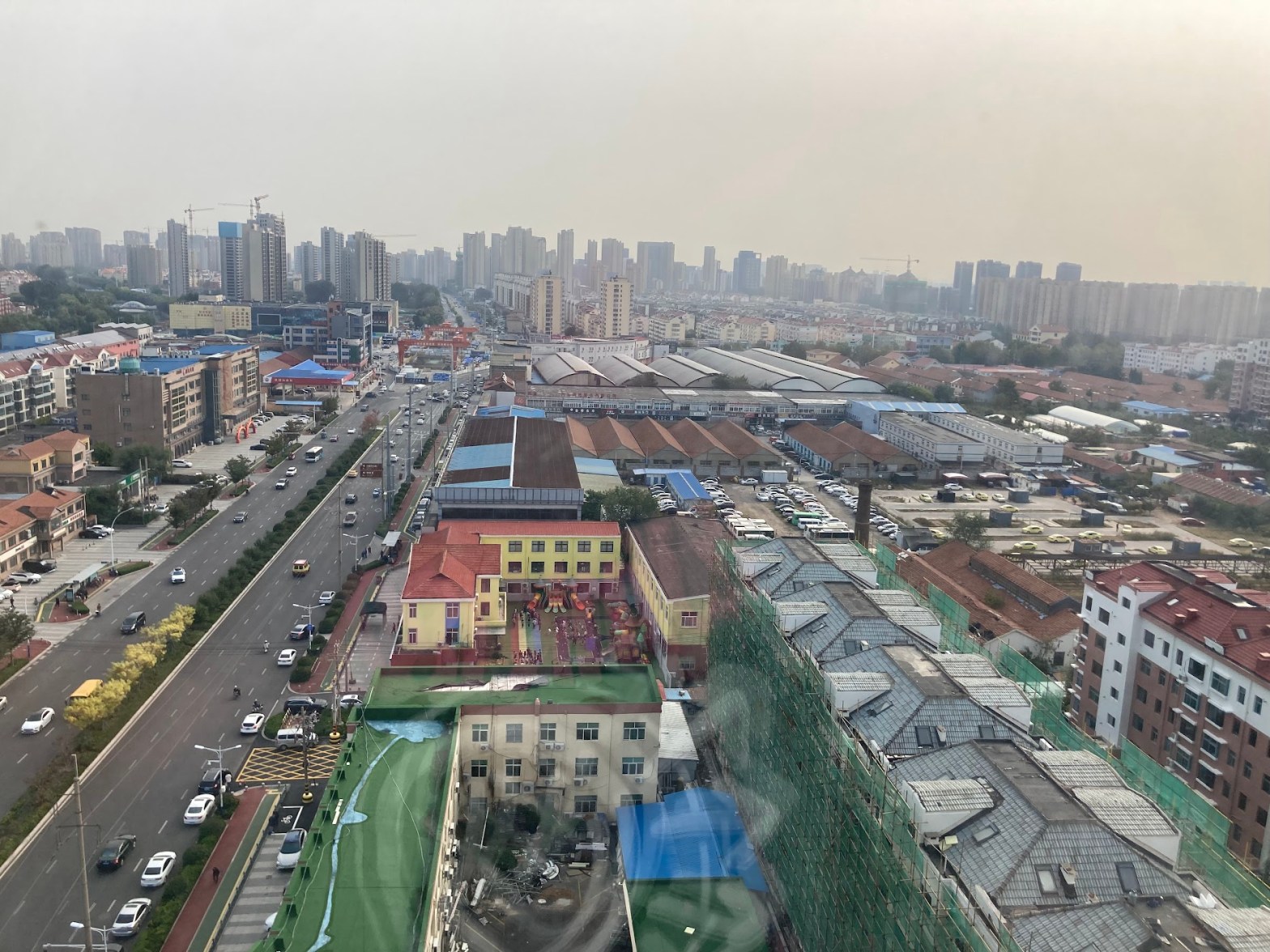
At breakfast, we met an American bloke who had recently married a girl from Shuyang. She lived in the states but they were back over here for a wedding or meeting the family. What a cultural trip for him! No doubt he was forced into some very heavy baijiu drinking at least one night and suffered for a day or two after. Poor bloke. Shuyang is a grey, industrial place, a bit like Ligezhuang and Jiazhou. Probably not a place one would choose to live given the option, but reasonably quiet and developed. Electric cars are humming everywhere as usual.
Cathleen and her brother drove us for an hour to another station called Huai an Dong which was planted alongside the freeway in the middle of nowhere it seemed. Another mammoth high-speed train station as big as an airport. It had three levels, a Mcdonalds and many shops, but was quiet and pleasant.
On the train, Steve and I told stories of our train trips whilst living here years ago. Failing to get a real ticket so being forced to sleep under seats on the 1am to 2pm Xi’an to Beijing slow train, half an ass cheek on a seat for five minutes while a bloke went to smoke a ciggie in between carriages. It was a pretty horrible team building experience for the guys involved and a tough sell for the person in charge of getting the tickets.
Dinner and many drinks in the meal carriage. These don’t exist in the new trains. The romance of the hard sleeper. Lights out very early, then the growing chorus of snores, a single snorer slowly becoming an orchestra. Six beds per compartment, the lowest one the most expensive but the best as no climbing required. Yet often a congregating place for everyone to sit and chat. ‘What do you do?’ ‘How much do you earn?’ The highest bed was for thrifty people who wanted to save a few bucks and was particularly fraught for drunks trying to climb up after a few beers at the meal carriage. Getting back to one’s bed drunk in the dark and actually finding your compartment was always hard. Not to mention the shaking toilet on the way. And as one’s life circumstances improved, the luxury of the soft sleeper. I remember observing a conversation between a uni student and an old bloke. He was snoring vociferously. She woke him up.
Her: ‘You’re snoring too loudly. I can’t sleep.
Him: ‘What should I do?’
Her: ‘Stop it?
Him: ‘But then I won’t be able to sleep.’
Her: Shoulder shrug.
I chuckled along watching the confidence of the new youth take on the older generation. They both had a point.
Steve and I speculated about the ever changing forces rolling across the country. EVs are everywhere (you can spot them because they have different number plates) and so are electric cars made by numerous new local car companies. Masses of empty buildings alongside the train line. It must be a scam somehow but we don’t know how it works.
Everything is on such a huge, mind boggling scale and who really knows how it all works. The huge train stations and freeway overpasses. We just enjoy the craziness of it all as we always have. The chaos and constant change and upheaval were major attractions for those great years.
Even now there are many things we like and laugh at or are confused by or that annoy us. Enjoy the train noise. It’s funny. Enjoy the lack of personal space. I bumped into a guy at the train station and neither of us broke stride. Enjoy the chaos and strangeness. Enjoy the waitress at dinner who stopped working to watch us converse and then chime in with a few comments. Enjoy the food and the smells and the clean public toilets! Just bring your own toilet paper.
The climate started to change as we headed south towards Shanghai. Slowly the fields were greener. The country is so huge that one can only imagine the lives of those Chinese living in the in-between places. We were lucky to have an insight into Shuyang and Ligezhuang and meet some of the locals.


Finally got around to reading this – nice write-up again!
Agree that the bullet trains are impressive – but this journey hardly is gonna hold the same space in your heart in 20 years as 北京站 bedlam does now. And doing away with dining cars is one of the great disasters of 21st century civilization!
LikeLike
https://www.economist.com/europe/2024/12/31/a-prague-berlin-train-loses-its-old-world-dining-cars
Looks like the Economist thinks so too!
LikeLike