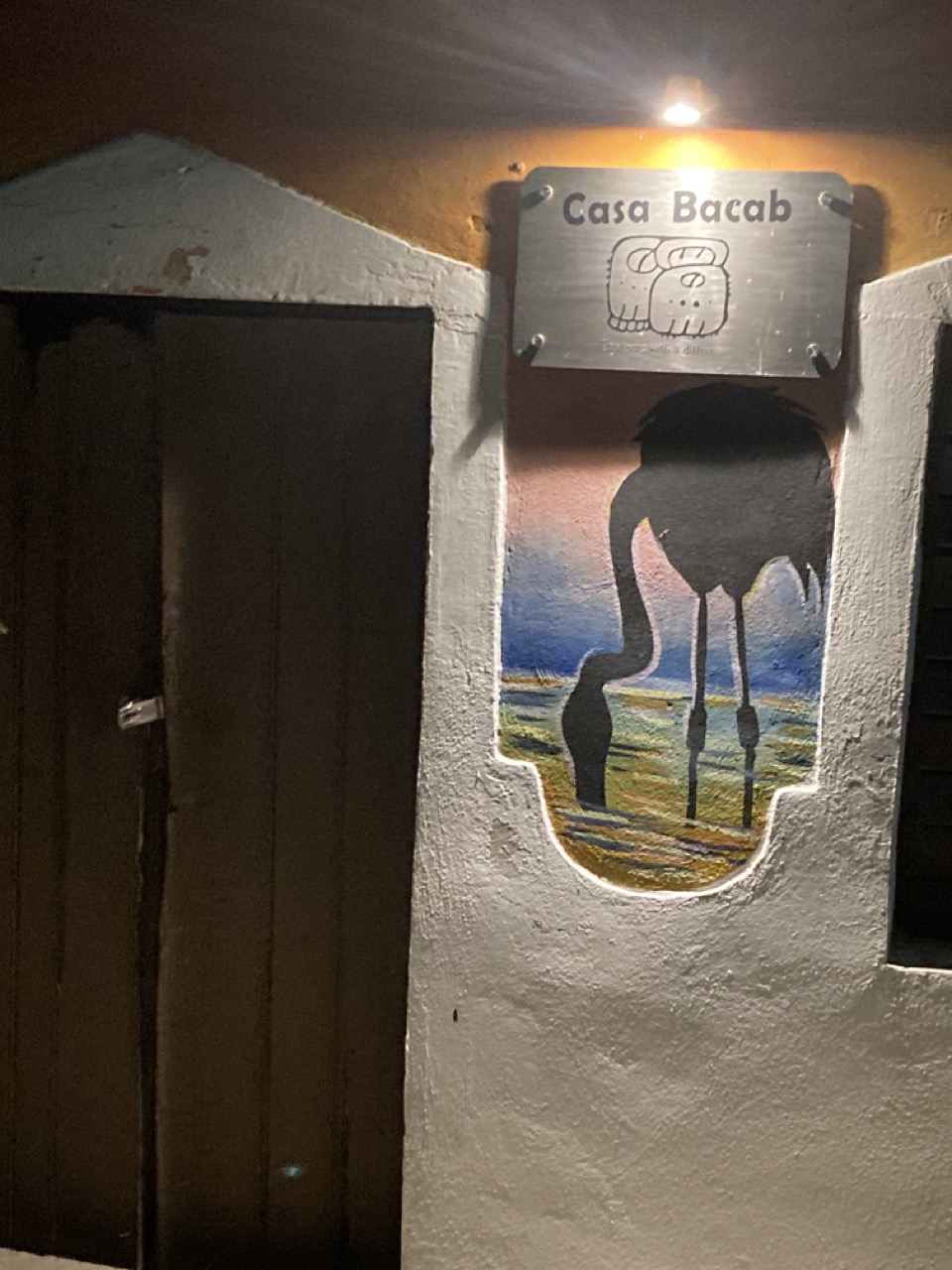
Our first full day on holiday in southern Mexico. We had a full day free in the small seaside town of Celestún after our boat tour was canceled. I turned my head, and in a small street off the main drag was a cafe sign. We approached with apprehension, as Celestún is a small place offering predominantly simple pleasures like fresh seafood on the sand and cold beers by the water yet largely devoid of the modern yuppy luxuries we were used to in our highly gentrified part of Mexico City, i.e. high-quality coffee with various milk options, fresh croissants, deluxe breakfast choices, vegan options. Or so we thought.

On closer inspection, on offer was coffee, tea, art and books! One of us focused on the first word, the other on the last. I entered excited to peruse the literary offerings, a firm believer that holiday books should come to you, and appear in your path ‘for a reason’ (the James Patterson book I read later provided solid contradictory evidence) even if that reason is to bore one to death or force one to hate-read hundreds of pages due to lack of alternatives.
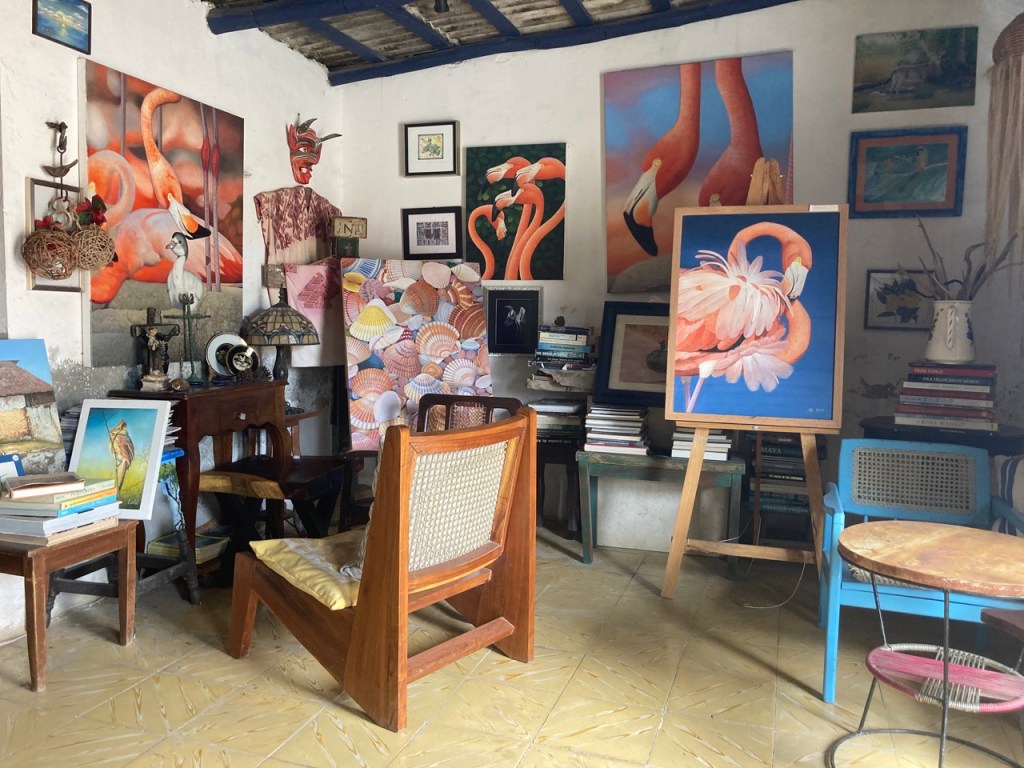
A simple house with colourful murals of birds painted on the front wall. Open on a Monday morning, but not the type of place that keeps regular hours or even acknowledges weekends and weekdays. Not a novel in sight inside, but nearly every flat surface covered with bird books in multiple languages, if that’s your cup of tea. I admit that it’s not mine, slightly ashamed of my ignorance. Embracing birding (as it is called, apparently) as a hobby is an admission to middle age that one does not easily make.
Welcome to Casa Bacab. Withhold your first impressions.
Mine were none-too-flattering. From my notes, handwritten, ever the anachronist: An old house, dimly lit, converted halfheartedly into a cafe, lacking places to sit or any wait staff, really full of junk, lots of old mismatched furniture scattered about, not too many flat surfaces for coffee or food. A few chairs. No good books. Disorder the overarching theme.
Enter David, an inspiring character one might meet in the first few days of a holiday, when one sees the world differently and is most open to new conversations and local expertise. The boss and sole staff member, an avid birder. Indeterminate age, a general enthusiast who swung into English to explain things.
One other customer was outside in the already unforgiving 9am sun, and we explored the house to find a courtyard in the shade out the back. A cool breeze, what a haven. A coffee, world-class, served in nice clean mugs. Later David confessed that he doesn’t sell takeaways, rejecting customers who ask for them. A vegetarian also, so a kindred spirit from the start.
The outside area was super messy, just nicknacks everywhere. The standout was a stone sculpted penis sitting in the corner, massive, much bigger than human size. Later he told us that it was sculpted by a friend who had been in prison and gave it to him as a gift and not for the first time I thought that maybe I had misunderstood, as that story was told in Spanish. I didn’t probe.
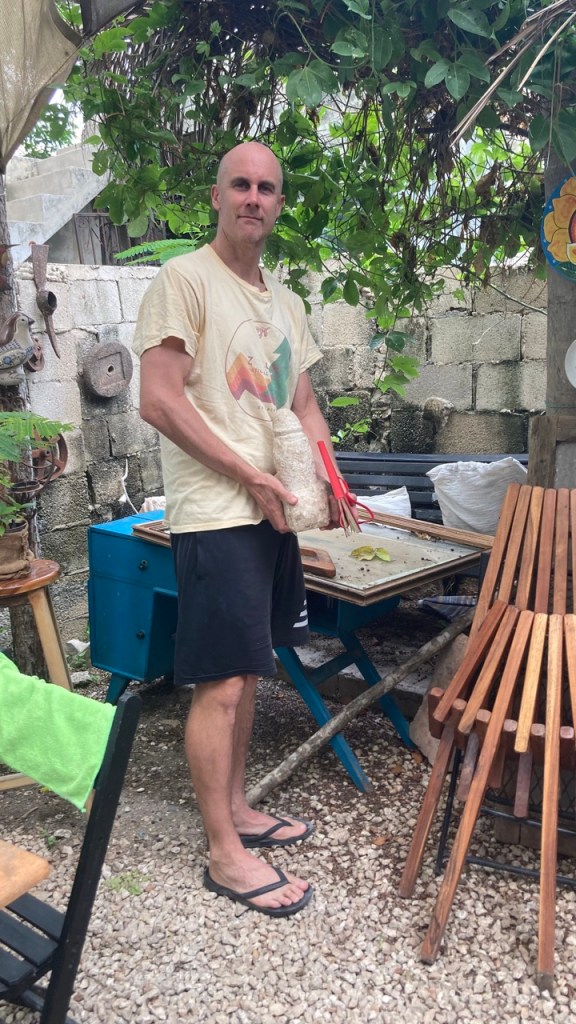
On further exploration I found a kitchen in disarray, then walked through to a squalid outdoor toilet, quite dirty, sort of off limits, and a single bed in a corner in a darker room. Given autonomy, independence and solitude, most men will gravitate towards simplicity, messiness and squalor, especially in the earlier and later stages of their lives. No roof on the bathroom, so choose your moments in the wet season or enjoy some all-in-one natural ablutions, the storms in southern Mexico being quite formidable.
All in all not the type of place where one has faith in the menu, which was ambitious, but we ordered to find out, as we had no other plans for the day.
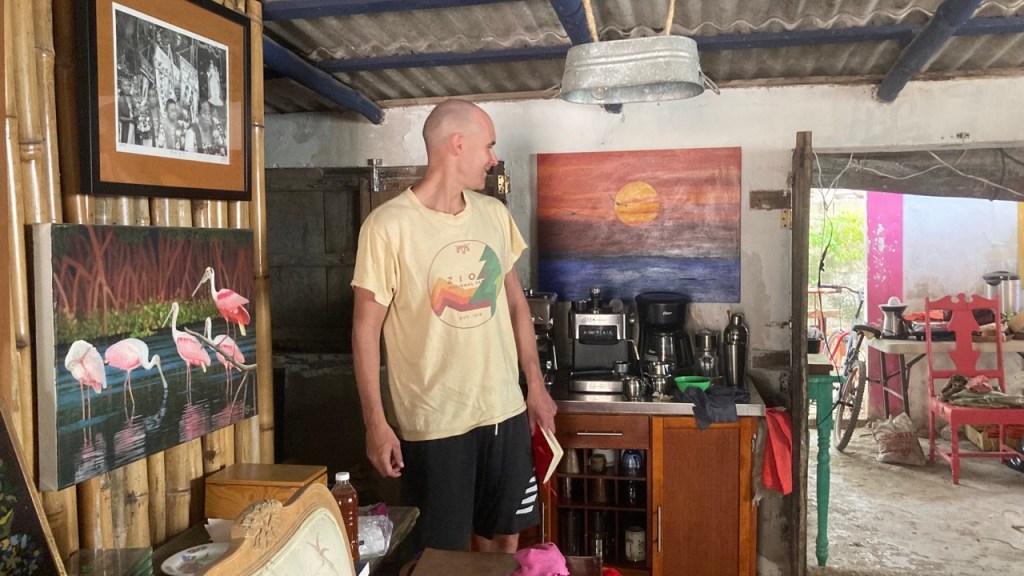
David disappeared into his nook and left us to observe the different junk/stuff around us. Here our first impressions were debunked. Every time you turn your head you see something cool/weird. He had taken over the house when his parents passed away. It is the family home where he and his numerous siblings (six?) grew up, and it seems he is halfway through tidying up, yet still bringing things in, so the place is dishevelled in a charming way. Far from a hoarder, David had retained artefacts and many items of sentimental value.

He emerged, unrushed, 10-15 minutes later with a world-class breakfast. Hotcakes for me, eggs for Kari. Incredible that it emerged from there. He sat and told some of his story, forthcoming but not overbearing. An expansive host and conversationalist, rare these days. His family name is Mayan. He traveled as a tour guide for over a decade. One time he took a group of birders for a couple of weeks in Yucatan and his tip, somehow, was a one-year, all-paid scholarship to Cornell University. That was back in ‘94.
He is a jack-of-all-knowledge, but not a know-it-all, a guide, an expert in archaeology, birds, nature, Yucatan history etc, and the role model for other guides in the small, tourism-based town of Celestún.
Don’t put too much importance in first impressions. In time, you realise that this stuff isn’t junk. There are lots of different lights hanging from places. A bicycle. Black and white family photos. Incredible bird paintings by legit artists, some for sale, some just hanging. Some random Mayan nicknacks/artefacts, clothes, a scary hand-carved face, a table full of glasses like the Jimmy Eat World song and mugs, various chairs scattered if you need a seat. A classical guitar. So many tables, so little order. A feast for the eyes, more a disorganised museum than a cafe.
Our day took shape when he told us that a mangrove tour was essential and called his friend who would be her in 15 minutes. Soon we left in a moto-taxi.
TOUR
As our tour guide, Onésimo, said, this town is 80% fishing employment and 20% tourism. It might be an exaggeration but makes sense. The town is surrounded by protected manglares (mangroves) that were planted 20-25 years ago as a way to fight the effects of climate change. As Onésimo said, un soldado en la guerra contra cambio climatico. So there is not much land available or easy access to Celestún, keeping it quite isolated in an area where beachside towns are often overrun with tourism and development. Previously there was no bridge so the place was even more separated. The kids, big families back in those days, grew up on the water with not a whole lot to do but plenty of food in the ocean at least.
A year ago a hurricane had come through and apparently the town was still recovering.
Onésimo took us on a tiny little canoe through the manglares. A wide open lake, very shallow, just the sound of slow movement. He wasn’t really paddling but reaching in with a stick and pushing the earth, the stick coming up covered in a white layer of sediment. This is el baño maya, a Mayan bath, the sediment a natural antioxidant. Put it on your body and face for skincare. If you can bear the smell, earthy and stinking, quite malodorous, you can save yourself thousands on L’oreal or other such bunk. We smudged a bit on our feet and legs. The earth under the water was fangoso, as Onésimo repeated. I thought it meant fungal. It meant muddy.
We stopped at some small trees and he showed us the leaves that gathered salt on their surface throughout the day. There was a thin lining of salt on the leaf, so lick it. Or you could laboriously wipe salt into a bag and collect it and come back daily and easily meet your salt quota. Salt comes up as filtration. Then it flies away and new salt comes up again.
The mangroves grow about 20cm in height per year, so a metre every five years. They were about four metres high after 20 years growing. Onésimo showed obvious pride in this ecological project, a rare sort of victory in the fight against development, which can be indiscriminate and thoughtless in tourist areas, where $ is priority 1-10 and nature 11 onwards. This project was a model for other places apparently, the mangroves a fine, quiet place.
We paddled into the ‘tunnel’. It was a narrow little river, slightly cooler away from the heat. Huge spider webs (telarañas) hung from trees above, tiny birds, kingfishers (el martín pescador), colourful and hard to find but worth it. I felt a minor envy for a keen birder, searching/waiting for a rare species, on a stake out.
Onésimo provided a constant stream of knowledge, beginning each sentence with our first names, not over the top or annoying. He was a talented guide, clear Spanish, explaining the purpose of the mangroves, the birds, the flamencos/flamingos, quite absent until they migrate here in huge groups from November onwards. Hundreds altogether would be quite a site. They can fly 80km in a day but often fall and get injured. Surely I was not the first or last tourist to wonder at the connection between flamencos (the birds) and flamenco (the style of Spanish music).
At one stage we slowed and his descriptions paused and we sensed his sense of occasion, perhaps even awe, probably rare for someone who spends most days here. He slowed the boat and whispered, a gentle hand on the shoulder. A crocodile was close, completely stationary, as if dead, camouflaged in the water, just the tip of the nose and eyes above the surface. It was a crocodylus moreleti, mainly harmless. Was he asleep? As our guide explained, the croc was blowing bubbles under the water as a lure for unwitting birds to swoop thinking it is only a fish, only for him to awaken and launch his attack.
He was hunting. In an eternally patient manner. We hadn’t the time to sit and wait for something to happen and at five metres away we weren’t sure we wanted to see him suddenly open his gullet and savage his prey.
At that moment, in total silence, we spotted a bird, graceful, upright, also well camouflaged and 100% still, so still it took us some moments to even notice. A garza, a heron. Both animals were frozen. A painting. The bird beautiful, yet a few moments from a possible death and completely unaware. Wouldn’t we all like to spend our last moments in grace and peace, before it all ended spectacularly and instantly? The tunnel was idyllic, quiet, just the gentle push of the boat and a few insects. Cangrejos, crabs, scattered along the bank. There was the beautifully-named cangrejo violinista. Rays of sun broke through the canopy above, surely there was no menace looming below. We waited a few more minutes, but the animals, oblivious to us mere humans, continued their waiting game and we went on.
Onesimo explained more about the root systems, the nests, the interaction of all the living things in the ecosystem, mostly lost on this city guy, always a struggle in science, also struggling with the unknown vocab of bird life in Spanish.

We returned exhausted from the tour. David and Jesús, his protege, were out in the courtyard sharing one of those huge beers (940 ml) in the shade. A caguama. A mindblowing discovery for my semi-alcoholic 25-year-old self on my first trip to Mexico back in ‘07. We settled for a much needed cold beer and he shuffled to the kitchen to knock up another great meal, probably a bit annoyed that we interrupted his slow Monday afternoon and asked for some food. He came back soon with an amazing light lunch, a salad of watermelon, tomato, radish and avocado and a potato and zucchini dish in tomato sauce. Top notch.
David then held court and planned the next few days of the trip, in Spanish now. Cancun, Cozumel, Playa del Carmen, the main tourist destinations in this part of the country, to be given a wide berth, don’t bother. Chichen Itza, the most famous Mayan Archaeological site, ‘don’t bother, tourist trap’, go to this site, go to this beach. 100% faith in his recommendations. Take these numbers, call my friends. El Tren Maya, recently opened, was recommended, surprisingly, so that became an option. Our vague plans were suddenly abandoned and new ones made. How the unplanned holiday can take random different directions when you meet someone helpful and talkative. That was the payoff of only booking the first evening. No commitments.
Jesús had been trained to use the coffee machine and went to prepare coffees with a keen sense of responsibility. I took another tour round the house, spotting something new and random at every turn. We had coffee, some beers on the beach and a roughly planned trip ahead.


Nice write-up mate, looking forward to more vignettes from Mexico. Love how your travels, just like your holiday books, just come to you!
LikeLike